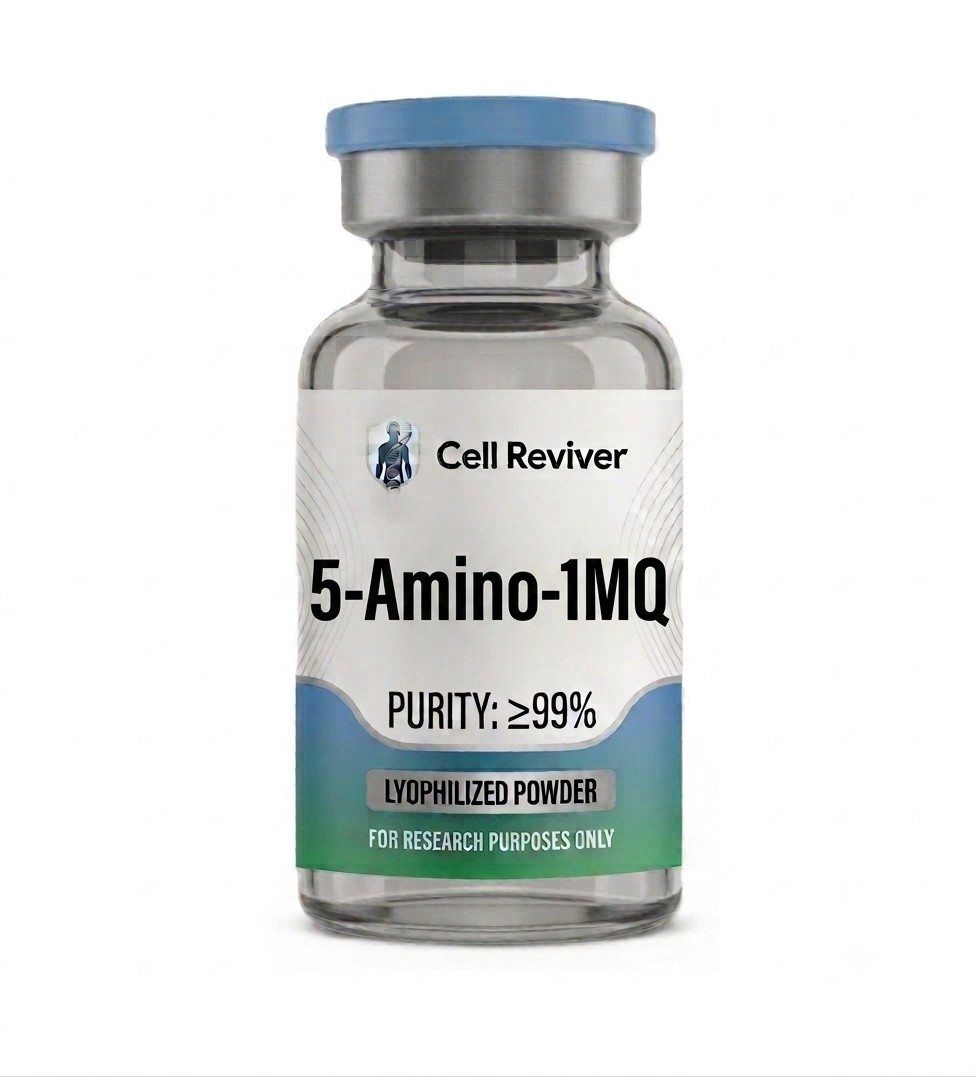
5-Amino-1MQ Research Information
NNMT Inhibitor
For Metabolic & Cellular Energy Research
️ Important: This information is for educational and research purposes only. Always consult with a qualified healthcare professional before use.
Contents
What is 5-Amino-1MQ?
5-Amino-1MQ (5-Amino-1-methylquinolinium) is a small-molecule, selective inhibitor of nicotinamide N-methyltransferase (NNMT) that has garnered significant attention for its potential therapeutic applications in metabolic diseases [2][4]. It is a potent and selective NNMT inhibitor with an IC50 value of approximately 1.2 μM [7][12].
5-Amino-1MQ functions as a membrane-permeable compound that selectively binds to the NNMT substrate binding site, preventing the methylation of nicotinamide [4][8]. 5-Amino-1MQ is available in pen and freeze-dried vial formulations for research purposes.
How 5-Amino-1MQ Works
5-Amino-1MQ works through a targeted mechanism to enhance cellular energy metabolism:
NNMT Inhibition
Selectively inhibits NNMT, preventing methylation of nicotinamide [4][8]
NAD+ Elevation
Preserves nicotinamide for NAD+ synthesis, increasing NAD+ levels [4][8]
SIRT1 Activation
Increased NAD+ activates SIRT1, enhancing fatty acid oxidation [6][8]
The inhibition of NNMT by 5-Amino-1MQ increases intracellular NAD+ levels by 1.2- to 1.6-fold [7]. This leads to activation of SIRT1, which stimulates PGC-1α and drives fatty acid oxidation and enhanced energy expenditure [6][8]. The compound has shown in vivo efficacy in murine models of diet-induced obesity (20 mg/kg/d sc.) with no adverse effects up to 60 mg/kg/d [12].
Research Applications
Metabolic Research
Studying NNMT inhibition for obesity, insulin resistance, and metabolic dysfunction [3][11]
NAD+ Metabolism
Investigating NAD+ salvage pathway and cellular energy homeostasis [4][8]
Muscle Regeneration
NNMT inhibition promotes myoblast differentiation and muscle stem cell regeneration [5][8]
Cellular Energy
Researching energy expenditure and mitochondrial function [3][6]
Clinical Studies
Preclinical Studies – Diet-Induced Obesity (DIO) Models
- 5-Amino-1MQ (20 mg/kg/d sc.) in DIO mice reversed obesity, decreased white adipose tissue mass, and lowered plasma cholesterol without altering food intake [7][8]
- Resting energy expenditure increased by 15-20% in rodent studies [3]
- Fat mass dropped by 10-25% over 4-6 weeks in diet-induced obese rodents [3]
- Improved insulin sensitivity and reduced fasting glucose and insulin levels [3]
- No adverse effects reported up to 60 mg/kg/d in animal studies [12]
Muscle Regeneration Research
- NNMT inhibition promotes myoblast differentiation in vitro and enhances fusion and regeneration capacity of muscle stem cells in aged mice [5][8]
- In aged mouse models, improvements in muscle endurance and strength through enhanced NAD+ synthesis and mitochondrial function were observed [7]
Human Clinical Trial Status
- As of 2026, no human clinical trials have published definitive results on 5-Amino-1MQ [3][11]
- Phase 1 human trials have been registered in some geographies, but published human efficacy data are not yet mature [11]
- 5-Amino-1MQ is not on the FDA 503A bulk drug substances list [11]
- Not approved by FDA, EMA, or other regulatory bodies for weight loss or any other use [3]
Interactive Dosing Guide
Select your vial size and dose to see the corresponding volume, clicks, dosing frequency, and how many doses per vial:
️ Step 1: Select Your Vial Size
Step 2: Select Your Dose
Common research protocols: 1-5 mg per injection. Preclinical studies used up to 20 mg/kg/d in animal models [7][12]
Vial Size
5mg Vial
Selected Dose
1 mg
Doses per Vial
5 doses
Pen Clicks
60 clicks
Volume
0.60 mL
Protocol Level
Level 1 (Starting)
Recommended Schedule
Daily - Loading Phase
️ Do not change your dose unless advised by a qualified professional.
Protocol Level Summary
Based on research protocols: 1-5 mg per injection, typically administered daily. Preclinical studies used 20 mg/kg/d sc. [7][12]
| Protocol Level | Target Dose | Frequency | 5mg Clicks | 10mg Clicks | 50mg Clicks | Who It\'s For |
|---|---|---|---|---|---|---|
| Level 1 (Starting) | 1 mg | Daily | 60 clicks | 30 clicks | 6 clicks | New users, first 2 weeks |
| Level 2 (Standard) | 2.5 mg | Daily | 150 clicks | 75 clicks | 15 clicks | After 2 weeks, maintenance |
| Level 3 (Advanced) | 5 mg | Daily | 300 clicks | 150 clicks | 30 clicks | If more response needed |
| Level 4 (Maximum) | 10 mg | Daily | 600 clicks | 300 clicks | 60 clicks | Experienced users only |
️ Do not change your dose unless advised by a qualified professional.
Vial Users (Insulin Syringe)
Add 3mL of bacteriostatic water to your freeze-dried vial and mix gently. After reconstitution, use the table below to draw your dose:
Vial Size
5mg vial with 3mL bac water
| Dose | Frequency | Units on Syringe | Volume (mL) | Protocol Level |
|---|
️ Always use a new sterile needle and syringe for each injection.
️ Safety & Precautions
5-Amino-1MQ has shown a favorable safety profile in preclinical studies. In animal models, no adverse effects were reported up to 60 mg/kg/d [12]. However, human safety data are very limited as no clinical trials have published definitive results [3][11].
- Injection site reactions: Mild redness or tenderness at injection site (preclinical)
- Gastrointestinal effects: Not reported in preclinical studies; no human data available
- Liver and kidney function: Normal in short-term rodent studies over 6-8 weeks [3]
Important Safety Considerations:
- 5-Amino-1MQ is not FDA-approved for any indication [3][11]
- No human dosing, safety, or efficacy has been established [9]
- Long-term safety has not been assessed in humans [3]
- Not on the FDA 503A bulk drug substances list [11]
- Do not use if allergic to 5-Amino-1MQ or any ingredients
- Do not use if pregnant or breastfeeding
️ Warning: 5-Amino-1MQ is an investigational research compound with no established human safety data. If you experience severe allergic reactions, difficulty breathing, or signs of anaphylaxis, seek immediate medical help.
References
- 5-Amino-1MQ Documentation Hub. Benchchem. December 2025. [4]
- 5-Amino-1MQ — Grokipedia. March 2026. [7]
- 5-Amino-1-methylquinolinium iodide Product Information. Cenmed Enterprises. [12]
- 5-Amino-1MQ Clinical Trials: 2026 Status and Fat Loss Mechanism. Newtropin Inc. May 2026. [11]
- 5-Amino-1MQ Results & MD Steps. Ubie Health. May 2026. [3]
- 5-Amino-1MQ 50mg (60 Capsules). Consentz. [9]
This information is for educational and research purposes only. Always consult with a qualified healthcare professional.
Last updated: July 2026