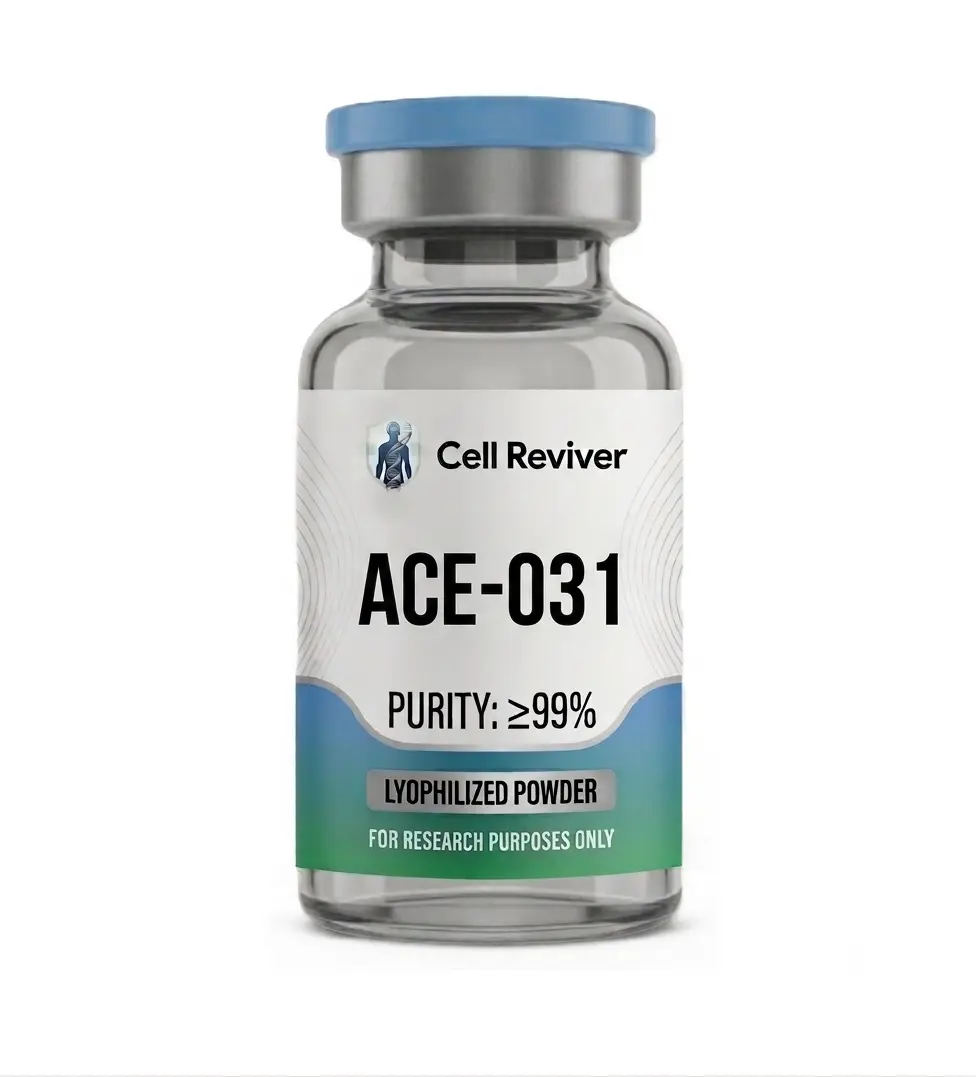
ACE-031 Research Information
Activin Receptor Type IIB Fusion Protein
For Muscle Growth & Myostatin Research
️ Important: This information is for educational and research purposes only. Always consult with a qualified healthcare professional before use.
Contents
What is ACE-031?
ACE-031 (Ramatercept) is a soluble homodimeric fusion protein consisting of the activin receptor type IIB (ActRIIB) extracellular domain fused to the Fc portion of human IgG1 [citation:1][citation:8]. It acts as a myostatin inhibitor by binding to myostatin and other negative regulators of muscle mass, disrupting their inhibitory effect on muscle development [citation:1][citation:2][citation:6].
ACE-031 has been investigated in clinical trials for conditions such as Duchenne muscular dystrophy and muscle wasting disorders [citation:3][citation:7][citation:10]. Despite promising results in Phase I and II studies, development was terminated due to potential safety concerns [citation:7][citation:8]. ACE-031 is available in pen and freeze-dried vial formulations for research purposes.
How ACE-031 Works
ACE-031 works through a targeted mechanism to promote muscle growth:
Ligand Trapping
Binds to myostatin and activin A, trapping and blocking negative regulators of muscle mass [citation:2][citation:8]
Muscle Growth
Increases lean body mass, muscle cross-sectional area, and force production [citation:1][citation:4][citation:6]
Metabolic Effects
Improves bone and fat metabolism in addition to muscle effects [citation:2][citation:6]
In non-human primate studies, ACE-031 administration resulted in significant increases in lean body mass, muscle fiber cross-sectional area, and force production [citation:1][citation:4][citation:5].
Research Applications
Muscle Growth
Studying myostatin inhibition and muscle hypertrophy mechanisms
Muscular Dystrophy
Potential therapeutic for Duchenne muscular dystrophy and other myopathies [citation:3][citation:7][citation:10]
Metabolic Research
Investigating effects on bone density and fat metabolism [citation:2][citation:6]
Sarcopenia Research
Studying age-related muscle loss and therapeutic interventions
Clinical Studies
Phase 1 Study in Healthy Volunteers (Muscle & Nerve 2013)
- 48 healthy postmenopausal women received a single dose of ACE-031 (0.02–3 mg/kg SC) or placebo [citation:2][citation:6]
- ACE-031 was generally well-tolerated; adverse events included injection site erythema [citation:2][citation:6]
- Pharmacokinetics: linear dose-proportional exposure; mean half-life of 10–15 days [citation:2][citation:6]
- At the 3 mg/kg dose, significant increases in mean total body lean mass (3.3%; P = 0.03) and thigh muscle volume (5.1%; P = 0.03) at day 29 [citation:2][citation:6]
- Statistically significant changes in serum biomarkers suggest improved bone and fat metabolism [citation:2][citation:6]
Duchenne Muscular Dystrophy Clinical Trial (Muscle & Nerve 2017)
- Ambulatory boys with DMD received ACE-031 subcutaneously every 2-4 weeks [citation:7]
- Trends for maintenance of 6-minute walk test distance and increased lean body mass and bone mineral density [citation:7]
- Study stopped after the second dosing regimen due to potential safety concerns of epistaxis and telangiectasias [citation:7]
- No serious or severe adverse events were reported [citation:7]
Non-Human Primate Study (2026)
- Marmosets received ACE-031 for 14 weeks [citation:1][citation:4]
- Significant main effect of time and time × treatment interaction for lean body mass [citation:1][citation:4]
- Biceps brachii exhibited significant increase in cross-sectional area of both type I and type II fibers [citation:1][citation:4]
- Ex vivo contractile properties showed increase in absolute and specific force production [citation:1][citation:4]
Clinical Development Status
- Development was terminated in Phase II due to potential safety reasons (nose bleeding, telangiectasias) [citation:7][citation:8]
- ACE-031 is not FDA-approved and no approved pharmaceuticals are available [citation:8][citation:9]
- Classified as a prohibited substance by WADA (chapter S4.3) [citation:8][citation:9]
- Sold on the black market as a research chemical [citation:8][citation:9]
Interactive Dosing Guide
Select your vial size and dose to see the corresponding volume, clicks, dosing frequency, and how many doses per vial:
️ Step 1: Select Your Vial Size
Step 2: Select Your Dose
Based on research protocols: 0.02-3 mg/kg in clinical studies . Doses are weight-based in human studies.
Vial Size
1mg Vial
Selected Dose
0.1 mg
Doses per Vial
10 doses
Pen Clicks
30 clicks
Volume
0.30 mL
Protocol Level
Level 2 (Standard)
Recommended Schedule
Dose dependent - Research Protocol
️ Do not change your dose unless advised by a qualified professional.
Protocol Level Summary
Based on clinical research protocols: 0.02-3 mg/kg in humans . Doses are weight-based.
| Protocol Level | Target Dose | Frequency | Pen Clicks | Volume (mL) | Who It\'s For |
|---|---|---|---|---|---|
| Level 1 (Starting) | 0.02-0.05 mg | Single dose | 6-15 clicks | 0.06-0.15 mL | Phase 1 dose range |
| Level 2 (Standard) | 0.1-0.2 mg | Every 2-4 weeks | 30-60 clicks | 0.30-0.60 mL | DMD study dosing |
| Level 3 (Advanced) | 0.5 mg | Every 2-4 weeks | 150 clicks | 1.50 mL | Higher dose range |
| Level 4 (Maximum) | 1 mg | Every 2-4 weeks | 300 clicks | 3.00 mL | Maximum dose tested |
️ Do not change your dose unless advised by a qualified professional.
Vial Users (Insulin Syringe)
Add 3mL of bacteriostatic water to your freeze-dried vial and mix gently. After reconstitution, use the table below to draw your dose:
Vial Size
1mg vial with 3mL bac water
| Dose | Frequency | Units on Syringe | Volume (mL) | Protocol Level |
|---|
️ Always use a new sterile needle and syringe for each injection.
️ Safety & Precautions
ACE-031 has shown a manageable safety profile in clinical studies. Common adverse events include injection site erythema . However, development was terminated due to potential safety concerns .
- Injection site reactions: Erythema, tenderness, or pain at injection site [citation:2][citation:6]
- Nose bleeding: Observed in some DMD study participants [citation:7][citation:8]
- Telangiectasias: Small dilated blood vessels near skin surface [citation:7][citation:8]
- Half-life: Long half-life of 10-15 days [citation:2][citation:6]
Important Safety Considerations:
- ACE-031 is not FDA-approved and development has been terminated [citation:7][citation:8]
- Classified as a prohibited substance by WADA (chapter S4.3) [citation:8][citation:9]
- Black market products may contain full-length activin receptor IIB instead of ACE-031 [citation:8][citation:9]
- Do not use if allergic to ACE-031 or any ingredients
- Do not use if pregnant or breastfeeding
️ Warning: ACE-031 is an investigational fusion protein with no FDA approval. Clinical development has been terminated. Black market products may be counterfeit. If you experience severe allergic reactions, difficulty breathing, or signs of anaphylaxis, seek immediate medical help.
References
- ACE-031, a soluble activin type IIB receptor, increases muscle mass and strength in the common marmoset. bioRxiv. 2026. [citation:1][citation:4][citation:5]
- Attie KM, et al. A single ascending-dose study of muscle regulator ACE-031 in healthy volunteers. Muscle & Nerve. 2013;47(3):416-423. [citation:2][citation:6]
- Campbell C, et al. Myostatin inhibitor ACE-031 treatment of ambulatory boys with Duchenne muscular dystrophy. Muscle & Nerve. 2017;55(4):458-464. [citation:7]
- Reichel C, et al. Gel Electrophoretic Detection of Black Market ACE-031. Drug Testing and Analysis. 2025;17(10):1934-1946. [citation:8][citation:9]
- NCT01239758 - Open-Label Extension Study of ACE-031 in DMD. ClinicalTrials.gov. [citation:10]
- NCT00755638 - Phase 1 Study of ACE-031 in Healthy Postmenopausal Volunteers. ClinicalTrials.gov. [citation:11]
This information is for educational and research purposes only. Always consult with a qualified healthcare professional.
Last updated: July 2026