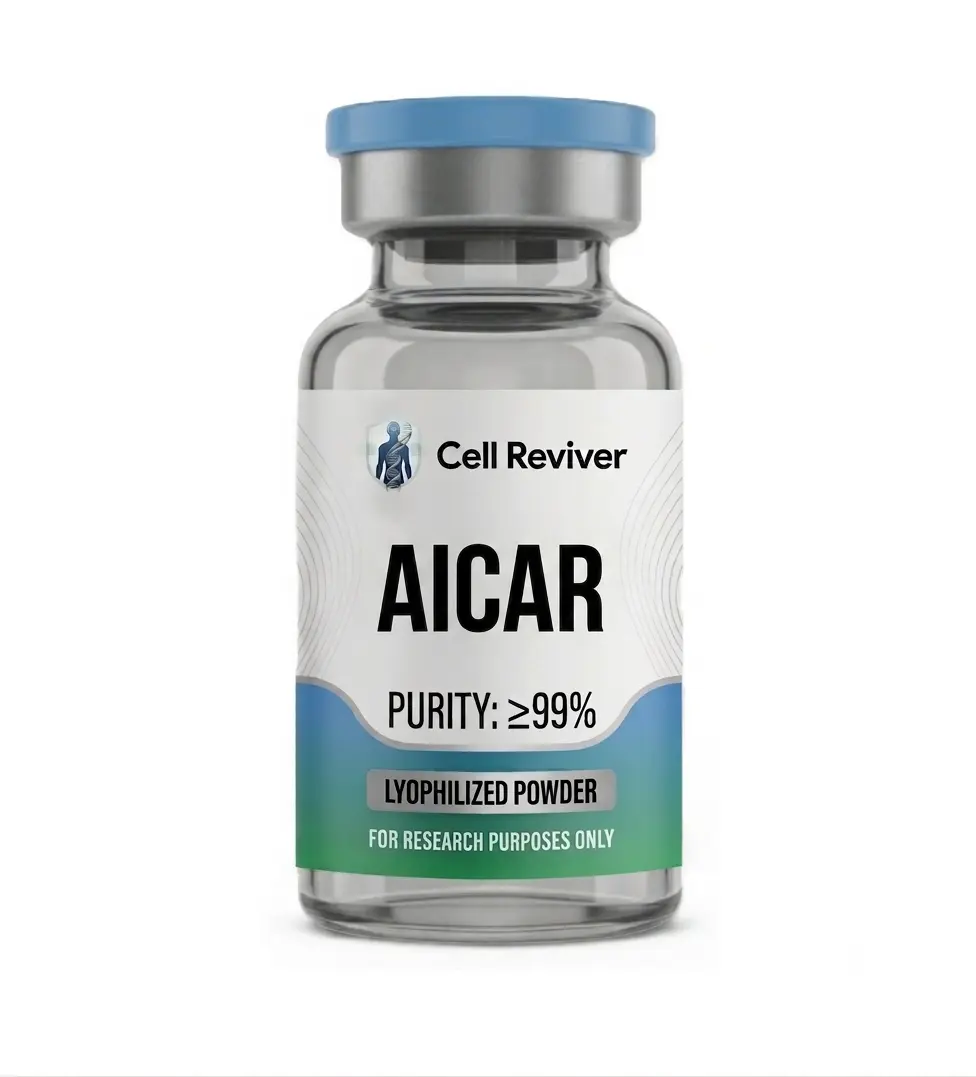
AICAR Research Information
AMPK Activator
For Metabolic & Endurance Research
️ Important: This information is for educational and research purposes only. Always consult with a qualified healthcare professional before use.
Contents
What is AICAR?
AICAR (5-Aminoimidazole-4-carboxamide ribonucleotide, also known as Acadesine) is a small molecule that activates AMP-activated protein kinase (AMPK), a key cellular energy sensor [citation:6]. It is a cell-permeable AMP analog that mimics AMP, triggering AMPK phosphorylation and downstream metabolic effects without altering cellular ATP, ADP, or AMP levels [citation:3].
AICAR has been extensively studied in research for its ability to mimic the metabolic effects of exercise, improve endurance, and provide therapeutic benefits in metabolic disorders, neuropathy, and inflammation [citation:6][citation:10]. AICAR is available in pen and freeze-dried vial formulations for research purposes.
How AICAR Works
AICAR works through multiple mechanisms to support metabolic health:
AMPK Activation
Directly activates AMPK, regulating cellular energy homeostasis and metabolism [citation:6]
Mitochondrial Biogenesis
Increases mitochondrial content and function, improving energy metabolism [citation:10]
Anti-Inflammatory
Inhibits NF-κB pathway and reduces inflammatory mediators [citation:9]
AICAR also promotes insulin sensitivity, glucose uptake, and fatty acid oxidation. In research models, it has been shown to reverse diabetic neuropathy, improve exercise performance, and reduce inflammation [citation:6][citation:10][citation:9].
Research Applications
Exercise Mimetic
Improves endurance and metabolic adaptations without physical activity [citation:10]
Metabolic Health
Studied for insulin sensitivity and glucose metabolism [citation:6]
Neuroprotection
Reverses diabetic neuropathy and protects against ischemic damage [citation:5][citation:6]
Anti-Inflammatory
Reduces inflammation in various disease models [citation:8][citation:9]
Clinical Studies
Diabetic Neuropathy Reversal (Johns Hopkins, 2025)
- In mouse models of both Type 1 and Type 2 diabetes, AICAR treatment prevented or reversed diabetic peripheral neuropathy [citation:6]
- AICAR (500 mg/kg) increased AMPK phosphorylation in DRG neurons by 3-fold (p < 0.001) [citation:6]
- Improved nerve conduction velocity, motor function, and intraepidermal nerve fiber density [citation:6]
Sarcopenia & Exercise Performance (2025)
- Chronic AICAR treatment (300-500 mg/kg, 31 days) in aged (23 months) mice prevented the 24.5% decline in treadmill running capacity seen in controls [citation:10]
- Quadricep weight increased by ~8% and tetanic force by 26.4% in AICAR-treated old mice [citation:10]
- Mitochondrial markers cytochrome C increased by ~33% and citrate synthase by ~22% [citation:10]
Cerebral Ischemia Protection (1990)
- AICAr (500 mg/kg) administered 30 minutes prior to a 5-minute ischemic episode significantly attenuated ischemic neuronal damage [citation:5]
- The 50 mg/kg dose showed a trend but was not significant [citation:5]
Anti-Inflammatory Effects (Uveitis Model)
- AICAR (50 mg/kg, i.p.) significantly reduced clinical severity of endotoxin-induced uveitis in rats [citation:9]
- Suppressed inflammatory mediators including TNF-α, CCL-2/MCP-1, and ICAM-1 [citation:9]
- Reduced NF-κB translocation and CD14 expression [citation:9]
Liver Lipid Metabolism (2025)
- AICAR (200 mg/kg/day) ameliorated PM2.5-induced hepatic lipid deposition, inflammation, and fibrosis in pregnant mice [citation:8]
- Reduced hepatic triglyceride levels and improved dyslipidemia [citation:8]
Interactive Dosing Guide
Select your vial size and dose to see the corresponding volume, clicks, dosing frequency, and how many doses per vial:
️ Step 1: Select Your Vial Size
Step 2: Select Your Dose
Common research protocols: 5-25 mg per dose. Preclinical studies used 50-500 mg/kg in animal models [citation:10].
Vial Size
50mg Vial
Selected Dose
10 mg
Doses per Vial
5 doses
Pen Clicks
60 clicks
Volume
0.60 mL
Protocol Level
Level 2 (Standard)
Recommended Schedule
Daily - Research Protocol
️ Do not change your dose unless advised by a qualified professional.
Protocol Level Summary
Based on research protocols: 5-25 mg daily. Preclinical studies used 50-500 mg/kg in animal models [citation:10].
| Protocol Level | Target Dose | Frequency | Pen Clicks | Volume (mL) | Who It\'s For |
|---|---|---|---|---|---|
| Level 1 (Starting) | 5 mg | Daily | 30 clicks | 0.30 mL | New users, first 2 weeks |
| Level 2 (Standard) | 10 mg | Daily | 60 clicks | 0.60 mL | After 2 weeks, maintenance |
| Level 3 (Advanced) | 15-20 mg | Daily | 90-120 clicks | 0.90-1.20 mL | If more response needed |
| Level 4 (Maximum) | 25 mg | Daily | 150 clicks | 1.50 mL | Experienced users only |
️ Do not change your dose unless advised by a qualified professional.
Vial Users (Insulin Syringe)
Add 3mL of bacteriostatic water to your freeze-dried vial and mix gently. After reconstitution, use the table below to draw your dose:
Vial Size
50mg vial with 3mL bac water
| Dose | Frequency | Units on Syringe | Volume (mL) | Protocol Level |
|---|
️ Always use a new sterile needle and syringe for each injection.
️ Safety & Precautions
AICAR has shown a manageable safety profile in preclinical studies. However, human safety data is limited and AICAR is not FDA-approved for any indication.
- Injection site reactions: Mild redness or tenderness at injection site
- Metabolic effects: AMPK activation can affect glucose and lipid metabolism
- Limited human data: No clinical safety data in humans
Important Safety Considerations:
- AICAR is not FDA-approved for any indication
- No human clinical safety data has been published
- Do not use if allergic to AICAR or any ingredients
- Do not use if pregnant or breastfeeding
️ Warning: AICAR is an investigational compound with no established human safety data. If you experience severe allergic reactions, difficulty breathing, or signs of anaphylaxis, seek immediate medical help.
References
- Chandrasekaran K, et al. Administration of AICAR, an AMPK Activator, Prevents and Reverses Diabetic Polyneuropathy (DPN) by Regulating Mitophagy. International Journal of Molecular Sciences. 2025;26(1):80. [citation:6]
- Wilcox SH, et al. Chronic treatment of old mice with AICAR reverses age-related changes in exercise performance and skeletal muscle gene expression. FAO/AGRIS. 2025. [citation:10]
- Dennis MR, et al. Cardiovascular and renal effects of AICAR in the DOCA-salt rat model of hypertension. Life Sciences. 2025. [citation:4]
- 5-Aminoimidazole-4-carboxamide riboside (AICAr) administration reduces cerebral ischemic damage in the mongolian gerbil. Brain Research. 1990. [citation:5]
- Takeuchi K, et al. Inhibitory effect of AICAR on endotoxin-induced uveitis in rats. Investigative Ophthalmology & Visual Science. [citation:9]
- AMPK agonist AICAR ameliorates maternal hepatic lipid metabolism disorder, inflammation, and fibrosis caused by PM2.5 exposure during pregnancy. Scientific Reports. 2025;15:8689. [citation:8]
This information is for educational and research purposes only. Always consult with a qualified healthcare professional.
Last updated: July 2026