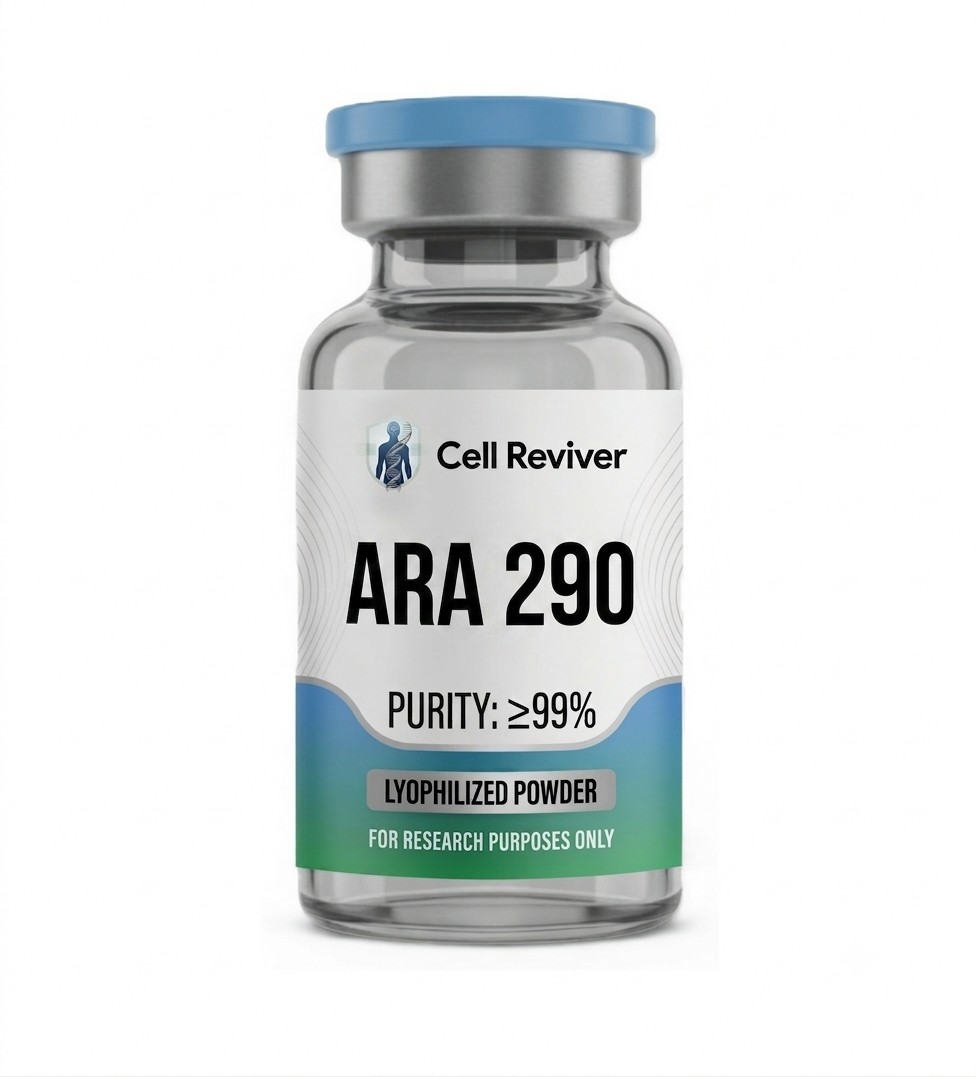
ARA 290 Research Information
Erythropoietin-Derived Peptide
For Neuroprotection & Tissue Repair Research
️ Important: This information is for educational and research purposes only. Always consult with a qualified healthcare professional before use.
Contents
What is ARA 290?
ARA 290 (also known as Cibinetide, PH-BSP, or Helix B Surface Peptide) is a synthetic 11-amino acid peptide derived from the structure of the B helix of erythropoietin (EPO) that has marked anti-apoptotic, anti-inflammatory, and tissue-protective effects [5][11]. It is designed to selectively bind to the innate repair receptor (IRR), recapitulating the beneficial effects of endogenous EPO without the hematopoietic side effects [10][11].
ARA 290 has a molecular weight of 1,257 Da and a short plasma half-life of approximately 20 minutes [10]. Despite its short half-life, ARA 290 triggers sustained biological effects when concentrations exceed the low nanomolar affinity of the IRR [10][11]. ARA 290 is available in pen and freeze-dried vial formulations for research purposes.
How ARA 290 Works
ARA 290 works through multiple mechanisms to provide tissue protection and anti-inflammatory effects:
IRR Targeting
Selectively binds to the innate repair receptor (EPOR/βCR heterodimer) [1][5][11]
Anti-Inflammatory
Reduces inflammatory cytokines (TNF-α, IL-1β, IL-6) and inhibits NLRP3 inflammasome [1]
TRPV1 Inhibition
Directly inhibits TRPV1 channel activity, relieving neuropathic pain [4]
ARA 290's tissue-protective effects are mediated through the β-common receptor (βCR/CD131), which forms a heterodimer with the EPO receptor that is rapidly upregulated following tissue injury [1][5]. ARA 290 reverses brain metabolic deviations in stroke by upregulating pathways involved in tyrosine metabolism, primary bile acid biosynthesis, and oxidative phosphorylation [1]. Unlike EPO, ARA 290 does not cause erythropoiesis, splenomegaly, or liver toxicity [1].
Research Applications
Neuroprotection
Reduced brain infarction and neuronal apoptosis in ischemic stroke models [1]
Metabolic Health
Improved HbA1c and lipid profiles in type 2 diabetes patients [10]
Neuropathic Pain
Relieves neuropathic symptoms and promotes nerve fiber regrowth [4][10]
Retinal Health
Phase II trial for diabetic macular edema (4 mg daily for 12 weeks) [9]
Clinical Studies
Ischemic Stroke – Preclinical (2024)
- In a mouse model of middle cerebral artery occlusion (MCAO), ARA 290 (30 μg/kg, twice daily) significantly reduced brain infarction volume and improved neurological function [1]
- ARA 290 significantly reduced neuronal apoptosis and inflammatory cytokines (TNF-α, IL-1β, IL-6) in brain tissue [1]
- ARA 290 reversed brain metabolic deviations in stroke by upregulating tyrosine metabolism, primary bile acid biosynthesis, and oxidative phosphorylation pathways [1]
- ARA 290 had no erythropoietic effects—no increase in red blood cells, hemoglobin, or spleen weight [1]
- No liver toxicity was observed (AST, ALT, LDH unchanged) [1]
- βCR siRNA significantly suppressed the neuroprotective effect, confirming β-common receptor is essential for ARA 290's action [1]
Type 2 Diabetes & Neuropathy – Phase 2 (2014)
- 49 patients with type 2 diabetes and painful neuropathy received 4 mg/day SC for 28 days [10]
- Significant improvement in HbA1c and lipid profiles throughout the 56-day observation period [10]
- Neuropathic symptoms improved significantly (PainDetect questionnaire) [10]
- Subjects with reduced corneal nerve fiber density showed a significant increase in CNFD [10]
- No safety issues were identified [10]
Sarcoidosis & Small Fiber Neuropathy – Phase 2 (2014)
- Dose-ranging study of 1, 4, or 8 mg/day SC for 28 days on corneal nerve fiber density [6][7]
- Primary endpoint: change in corneal nerve fiber density at day 28 vs baseline [6][7]
- Secondary endpoints: IENFD, pain scores (BPI, NPSI), QST, and 6-minute walk test [6]
TRPV1 Inhibition – Preclinical (2016)
- ARA 290 specifically inhibits TRPV1 channel activity [4]
- Relieves mechanical hypersensitivity induced by capsaicin [4]
- Functions as a novel antagonist for TRPV1 channel, integrating immune system and nociception [4]
Experimental Autoimmune Neuritis – Preclinical (2014)
- ARA 290 (30 mg/kg/day) effectively attenuated EAN disease severity [3]
- Reduced body weight loss and shortened EAN duration [3]
Interactive Dosing Guide
Select your vial size and dose to see the corresponding volume, clicks, dosing frequency, and how many doses per vial:
️ Step 1: Select Your Vial Size
Step 2: Select Your Dose
Clinical research protocols: 1-8 mg daily. Phase 2 studies used 4 mg daily for 28 days [10].
Vial Size
10mg Vial
Selected Dose
4 mg
Doses per Vial
2.5 doses
Pen Clicks
120 clicks
Volume
1.20 mL
Protocol Level
Level 2 (Standard)
Recommended Schedule
Daily for 28 days - Research Protocol [10]
️ Do not change your dose unless advised by a qualified professional.
Protocol Level Summary
Based on clinical research protocols: 1-8 mg daily. Phase 2 studies typically used 4 mg daily for 28 days [6][7][10].
| Protocol Level | Target Dose | Frequency | Pen Clicks | Volume (mL) | Who It\'s For |
|---|---|---|---|---|---|
| Level 1 (Starting) | 1 mg | Daily | 30 clicks | 0.30 mL | New users, initial protocol [6][7] |
| Level 2 (Standard) | 4 mg | Daily | 120 clicks | 1.20 mL | Clinical trial dose [10] |
| Level 3 (Advanced) | 8 mg | Daily | 240 clicks | 2.40 mL | Higher dose range [6][7] |
| Level 4 (Maximum) | 4 mg (IV bolus) | 1-3x weekly | 120 clicks | 1.20 mL | Rheumatoid arthritis protocol [2] |
️ Do not change your dose unless advised by a qualified professional.
Vial Users (Insulin Syringe)
Add 3mL of bacteriostatic water to your freeze-dried vial and mix gently. After reconstitution, use the table below to draw your dose:
Vial Size
10mg vial with 3mL bac water
| Dose | Frequency | Units on Syringe | Volume (mL) | Protocol Level |
|---|
️ Always use a new sterile needle and syringe for each injection.
️ Safety & Precautions
ARA 290 has shown a favorable safety profile in clinical studies. Unlike EPO, it has no erythropoietic activity—no increase in red blood cells, hemoglobin, platelet count, hematocrit, or spleen weight [1]. No liver toxicity was observed [1].
- Injection site reactions: Mild redness or tenderness at injection site
- No erythropoietic effects: Does not increase red blood cells or hemoglobin [1]
- No liver toxicity: AST, ALT, and LDH unchanged [1]
- Well-tolerated: No safety issues identified in Phase 2 trials [10]
Important Safety Considerations:
- ARA 290 is not FDA-approved for any indication
- Short half-life (~20 minutes) minimizes exposure to high concentrations [10]
- Do not use if allergic to ARA 290 or any ingredients
- Do not use if pregnant or breastfeeding
️ Warning: ARA 290 is an investigational peptide. If you experience severe allergic reactions, difficulty breathing, or signs of anaphylaxis, seek immediate medical help.
References
- Erythropoietin‐derived peptide ARA290 mediates brain tissue protection through the β‐common receptor in mice with cerebral ischemic stroke. NIH. 2024. [1]
- ARA 290 relieves pathophysiological pain by targeting TRPV1 channel. ScienceDirect. 2016. [4]
- Cibinetide (ARA 290) Ligand Page. IUPHAR/BPS Guide to Pharmacology. [5]
- Phase 2 Sarcoidosis Study. NTR. 2014. [6]
- Phase 2 Diabetes & Neuropathy Study. Springer. 2014. [10]
- Diabetic Macular Edema Phase II Trial. ICHGCP. 2024. [9]
- Cibinetide Overview. ChemicalBook. 2024. [11]
This information is for educational and research purposes only. Always consult with a qualified healthcare professional.
Last updated: July 2026