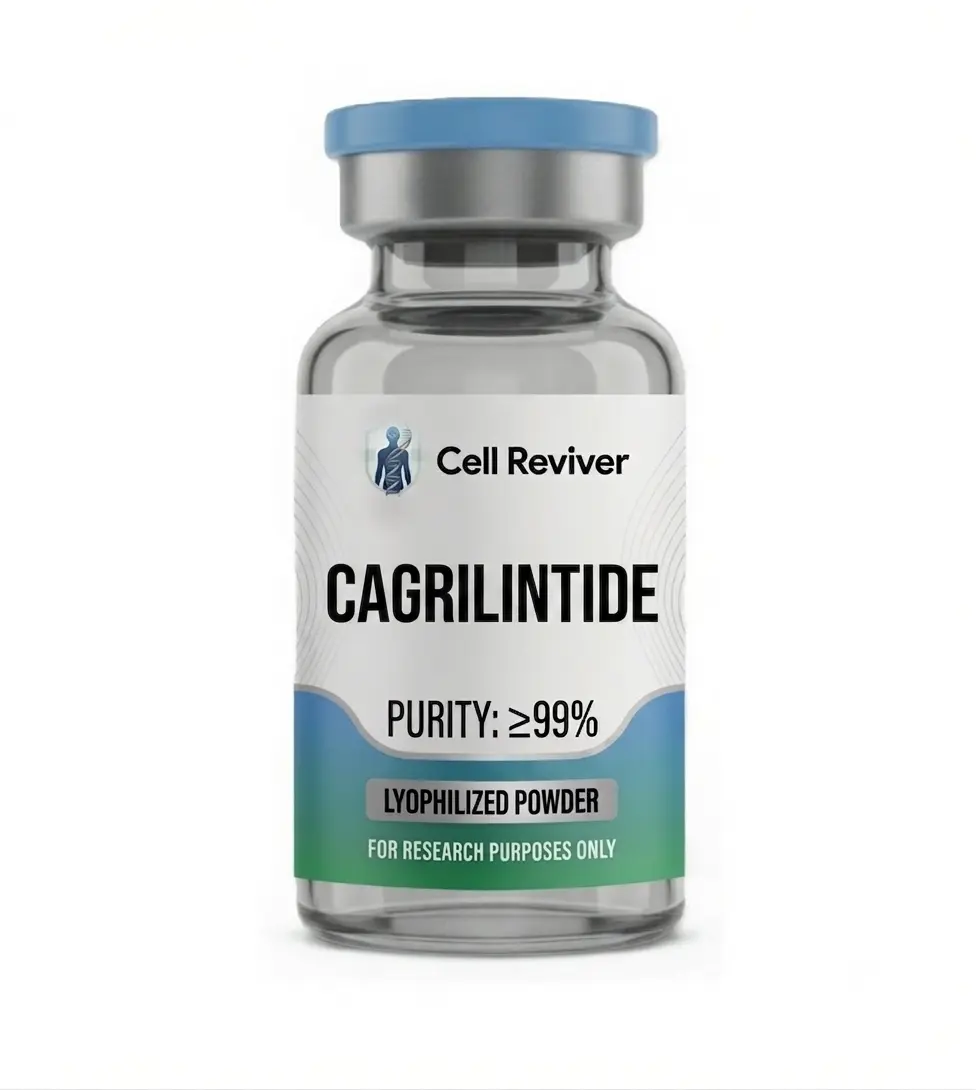
Cagrilintide Research Information
Long-Acting Amylin Analogue
For Metabolic & Weight Management Research
⚠️ Important: This information is for educational and research purposes only. Always consult with a qualified healthcare professional before use.
📑 Contents
🔬 What is Cagrilintide?
Cagrilintide is a long-acting amylin analogue currently under investigation for weight management. It is a 37-amino acid peptide that mimics the naturally occurring hormone amylin, which is co-secreted with insulin from pancreatic beta-cells and induces satiety. Cagrilintide is administered as a once-weekly subcutaneous injection at doses ranging from 0.3 mg to 4.5 mg.
Cagrilintide is available in pen and freeze-dried vial formulations for research purposes.
⚡ How Cagrilintide Works
Cagrilintide works by binding to both calcitonin and amylin receptors, which are G-protein-coupled receptors involved in metabolic regulation. This dual receptor activation induces satiety and reduces food intake.
Amylin Receptors
Induces satiety, reduces food intake, slows gastric emptying
Calcitonin Receptors
Modulates appetite regulation and energy balance
📋 Research Applications
Cagrilintide has been studied across multiple clinical trials, with research focusing on:
Weight Management
Phase 2 and Phase 3 trials show significant weight reduction in adults with obesity
Metabolic Health
Investigating effects on glucose homeostasis and blood pressure regulation
Kidney Physiology
Studies show cagrilintide may have diabetes-specific effects on kidney tubules
Monotherapy Research
First Phase 3 data for a long-acting amylin analogue as monotherapy for obesity
📊 Clinical Studies
Phase 2 Dose-Finding Trial (The Lancet 2021)
A multicentre, randomised, double-blind, placebo-controlled trial evaluated cagrilintide in 706 participants with overweight or obesity. The dose-response relationship showed:
| Cagrilintide Dose | Weight Loss at 26 Weeks | vs Placebo |
|---|---|---|
| 0.3 mg | −6.0% | −3.0% |
| 0.6 mg | −6.8% | −3.8% |
| 1.2 mg | −9.1% | −6.1% |
| 2.4 mg | −9.7% | −6.7% |
| 4.5 mg | −10.8% | −7.8% |
| Placebo | −3.0% | — |
Key finding: All doses of cagrilintide showed significant weight loss compared to placebo (p<0.001).
Phase 3 REDEFINE 1 – Monotherapy Results
Cagrilintide 2.4 mg monotherapy in 3,417 adults with obesity or overweight showed:
- −11.8% body weight reduction vs −2.3% with placebo
- 31.6% of participants achieved ≥15% weight loss vs 4.7% with placebo
- Most common side effects were gastrointestinal (nausea, vomiting, diarrhoea, constipation)
- Only 1.0% discontinuation due to nausea
💉 Interactive Dosing Guide
Select your pen size and dose to see the corresponding volume, clicks, dosing frequency, and how many doses per pen:
🖊️ Step 1: Select Your Pen Size
💊 Step 2: Select Your Dose
Pen Size
5mg Pen
Selected Dose
0.3 mg
Doses per Pen
16 doses
Pen Clicks
18 clicks
Volume
0.18 mL
Protocol Level
Level 1 (Starting)
Recommended Schedule
Once weekly - Loading Phase (Weeks 1-4)
⚠️ Do not change your dose unless advised by a qualified professional.
📋 Protocol Level Summary
Based on Phase 2 trial protocols:
| Protocol Level | Target Dose | Frequency | 5mg Pen Clicks | 10mg Pen Clicks | Who It\'s For |
|---|---|---|---|---|---|
| Level 1 (Starting) | 0.3 mg | Once weekly | 18 clicks | 9 clicks | New users, first 4 weeks |
| Level 2 (Early) | 0.6 mg | Once weekly | 36 clicks | 18 clicks | Weeks 5-8 |
| Level 3 (Standard) | 1.2 mg | Once weekly | 72 clicks | 36 clicks | Weeks 9-16 |
| Level 4 (Maintenance) | 2.4 mg | Once weekly | 144 clicks | 72 clicks | Week 17+ (Phase 3 dose) |
| Level 5 (Maximum) | 4.5 mg | Once weekly | 270 clicks | 135 clicks | Maximum dose tested |
⚠️ Do not change your dose unless advised by a qualified professional.
💉 Vial Users (Insulin Syringe)
Add 3mL of bacteriostatic water to your freeze-dried vial and mix gently. After reconstitution, use the table below to draw your dose:
Vial Size
5mg vial with 3mL bac water
| Dose | Frequency | Units on Syringe | Volume (mL) | Protocol Level |
|---|
⚠️ Always use a new sterile needle and syringe for each injection.
⚠️ Safety & Precautions
The most common adverse events in clinical trials were gastrointestinal disorders, primarily nausea, vomiting, diarrhoea, and constipation. These were mostly transient and mild to moderate in severity. Nausea led to permanent discontinuation in only 1.0% of participants.
Do not use if you:
- Are allergic to cagrilintide or any ingredients
- Are pregnant or breastfeeding
- Have type 1 diabetes
⚠️ Warning: If you experience severe and ongoing stomach pain, difficulty breathing, or signs of a severe allergic reaction, seek immediate medical help.
📚 References
- Lau J, et al. "Discovery and optimization of cagrilintide, a potent and long-acting amylin and calcitonin receptor agonist." Journal of Medicinal Chemistry. 2022.
- Gadde KM, et al. "Once-weekly cagrilintide for weight management in people with overweight and obesity." The Lancet. 2021;398:2160-2172.
- REDEFINE 1 Phase 3 Trial Sub-Analysis. European Association for the Study of Diabetes Congress. September 2025.
- Wulfmeyer VC, et al. "Exploration of Cagrilintide's Mechanism of Action in the Kidneys." Journal of the American Society of Nephrology. 2025.
This information is for educational and research purposes only. Always consult with a qualified healthcare professional.
Last updated: July 2026