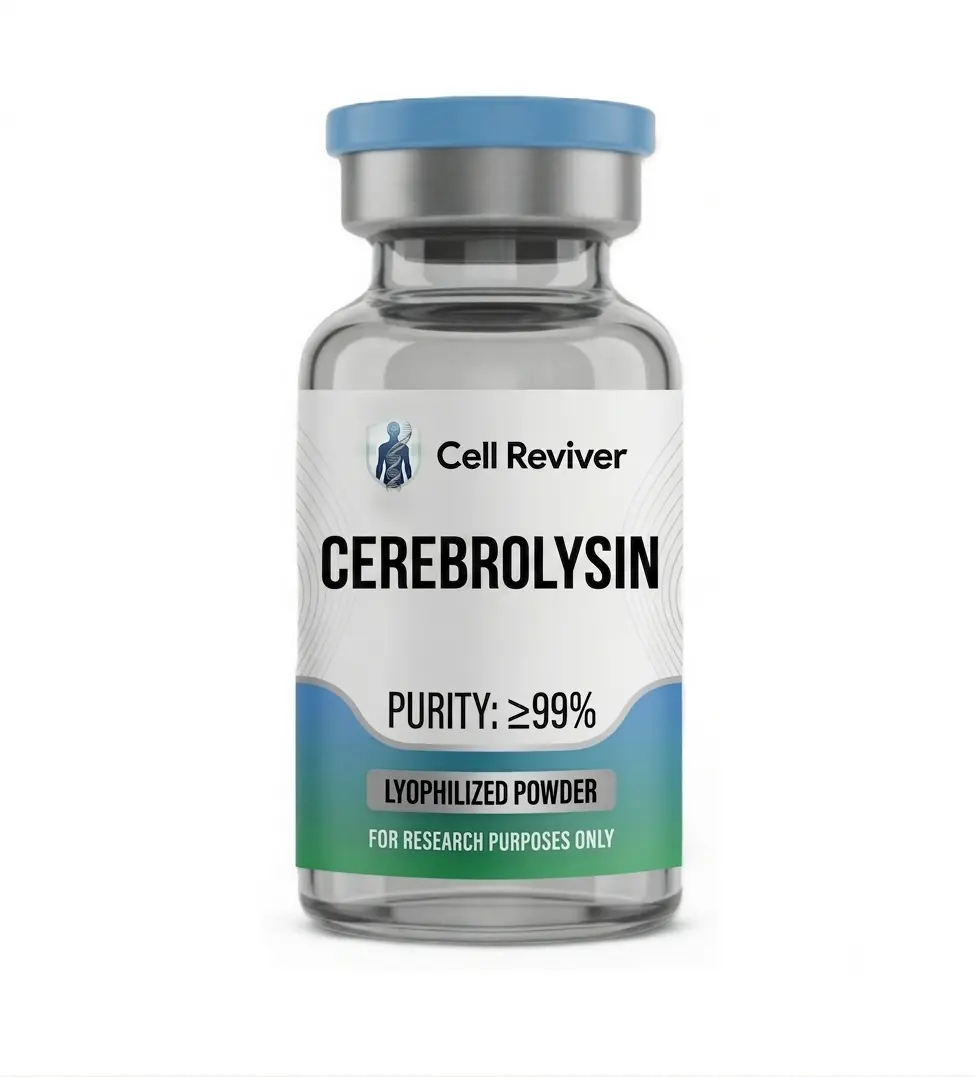
Cerebrolysin Research Information
Neurotrophic Peptide Complex
For Neuroprotective & Cognitive Research
️ Important: This information is for educational and research purposes only. Always consult with a qualified healthcare professional before use.
Contents
What is Cerebrolysin?
Cerebrolysin is a multimodal neuropeptide preparation derived from purified porcine brain proteins that contains a combination of low molecular weight neurotrophic peptides (25%) and free amino acids (75%) [citation:4]. It was developed in 1949 and is currently used in 44 countries, primarily in Europe and Asia [citation:4].
Cerebrolysin's low molecular weight allows it to freely cross the blood-brain barrier [citation:4]. It has been shown to have neuroprotective and neurorestorative qualities, promoting neuroplasticity, augmenting neurogenesis, and mitigating neuronal injury in various neurological conditions [citation:2]. Cerebrolysin is available in pen and freeze-dried vial formulations for research purposes.
How Cerebrolysin Works
Cerebrolysin works through multiple mechanisms to support neuroprotection and cognitive function:
Neuroprotection
Reduces oxidative stress, inhibits apoptosis, and promotes neuronal survival [citation:2]
Neuroplasticity
Enhances neurogenesis, synaptogenesis, and neuronal repair through BDNF stimulation [citation:2]
Anti-Inflammatory
Reduces neuroinflammation and activates anti-inflammatory mediators [citation:2]
Cerebrolysin activates the CREB/PGC-1α pathway, which is essential for suppressing neuroinflammation by reducing pro-inflammatory cytokines and promoting anti-inflammatory mediators [citation:2]. It also stimulates the production of brain-derived neurotrophic factor (BDNF), which is essential for neuronal repair and plasticity [citation:4].
Research Applications
Cognitive Function
Significant improvement in cognitive function in dementia and Alzheimer's disease [citation:1][citation:11]
Stroke Recovery
Improved functional outcomes and motor recovery in ischemic stroke [citation:3][citation:7]
Traumatic Brain Injury
Enhanced functional recovery and survival in moderate TBI with nonoperative ICH [citation:10]
Neuropsychiatric Disorders
Reduced cognitive impairment and neuroleptic side effects in psychiatric research [citation:4]
Clinical Studies
Dementia & Alzheimer's Disease
- A retrospective chart review of 25 patients with dementia found that cerebrolysin (60 mg daily for 20 days) produced significant improvement in cognitive scores (ACER and MMSE) with no major side effects [citation:1]
- In a randomized trial for Alzheimer's disease, cerebrolysin (60 mL daily) improved global clinical function and cognition at week 24 [citation:11]
- A systematic review of cerebrolysin in vascular dementia showed positive effects on cognitive performance and general functioning [citation:4]
Traumatic Brain Injury (TBI)
- A prospective cohort study of 340 patients with moderate TBI found cerebrolysin (30 mL/day for 10 days) significantly improved CRS-R scores at discharge (20.3 ± 2.7 vs 16.4 ± 2.1; p = 0.013) and 6-month survival (59.4% vs 27.8%; p < 0.001) [citation:10]
- Cerebrolysin reduced early brain damage following TBI by preventing neuroinflammation [citation:2]
- Recent clinical evidence encompasses 10 published studies in over 1,900 TBI patients [citation:2]
Stroke Recovery
- Multiple clinical trials (30-50 mL/day, 10-21 days) demonstrated improved functional outcomes in acute ischemic stroke [citation:3]
- A large study of 1,070 patients found cerebrolysin 30 mL/day for 10 days improved NIHSS, mRS, and Barthel Index at day 90 [citation:3]
Interactive Dosing Guide
Select your vial size and dose to see the corresponding volume, clicks, dosing frequency, and how many doses per vial:
️ Step 1: Select Your Vial Size
Step 2: Select Your Dose
Vial Size
60mg Vial
Selected Dose
10 mg
Doses per Vial
6 doses
Pen Clicks
50 clicks
Volume
0.50 mL
Protocol Level
Level 1 (Starting)
Recommended Schedule
Daily for 20 days - Loading Phase
️ Do not change your dose unless advised by a qualified professional.
Protocol Level Summary
Based on clinical research protocols: 10-60 mg/day for 10-21 days.
| Protocol Level | Target Dose | Frequency | Pen Clicks | Volume (mL) | Who It\'s For |
|---|---|---|---|---|---|
| Level 1 (Starting) | 10 mg | Daily | 50 clicks | 0.50 mL | New users, first protocol |
| Level 2 (Standard) | 30 mg | Daily | 150 clicks | 1.50 mL | Standard research dose |
| Level 3 (Advanced) | 50 mg | Daily | 250 clicks | 2.50 mL | Advanced research dose |
| Level 4 (Maximum) | 60 mg | Daily | 300 clicks | 3.00 mL | Maximum dose tested [citation:1][citation:11] |
️ Do not change your dose unless advised by a qualified professional.
Vial Users (Insulin Syringe)
Add 3mL of bacteriostatic water to your freeze-dried vial and mix gently. After reconstitution, use the table below to draw your dose:
Vial Size
60mg vial with 3mL bac water
| Dose | Frequency | Units on Syringe | Volume (mL) | Protocol Level |
|---|
️ Always use a new sterile needle and syringe for each injection.
️ Safety & Precautions
Cerebrolysin has shown a good safety profile in clinical studies, with no significant differences in adverse events reported [citation:10]. A meta-analysis indicates a very good safety profile of the substance [citation:4].
Do not use if you:
- Are allergic to cerebrolysin or any ingredients
- Have severe renal impairment [citation:2]
- Are pregnant or breastfeeding
Common side effects:
- Mild injection site reactions
- Rare cases of dizziness or headache
- No major side effects reported in dementia studies [citation:1]
️ Warning: If you experience severe allergic reactions, difficulty breathing, or signs of anaphylaxis, seek immediate medical help.
References
- Phirke M, Desousa A, Shah N, et al. The use of cerebroprotein hydrolysate in dementia: A case series of 25 cases. Journal of Geriatric Mental Health. 2014;1(2):106-109. [citation:1]
- Ellakwa DE, Mansour AS, Gorgui R, et al. Cerebrolysin in post-TBI recovery: Pharmacology and clinical evidence. ScienceDirect. 2025;39:102202. [citation:2]
- Cerebrolysin in Critically Ill Patients With Delirium. ClinicalTrials.gov. NCT06677502. 2024. [citation:6]
- Sakoolnamarka S, Urasyanandana K. Neuroprotective Effects of Cerebrolysin in Moderate Traumatic Brain Injury with Nonoperative Lesions. Asian Journal of Neurosurgery. 2025. DOI: 10.1055/s-0045-1813223. [citation:10]
- Alvarez XA, Cacabelos R, Sampedro C, et al. Efficacy and safety of Cerebrolysin in moderate to moderately severe Alzheimer's disease. European Journal of Neurology. 2011;18(1):59-68. [citation:11]
- Kobayashi A, Rutkowska K, Gocyla-Dudar K, et al. Safety and feasibility of cerebrolysin in treatment of primary intracerebral hemorrhage (CLINCH). Frontiers in Neurology. 2025;16:1602956. [citation:7]
This information is for educational and research purposes only. Always consult with a qualified healthcare professional.
Last updated: July 2026