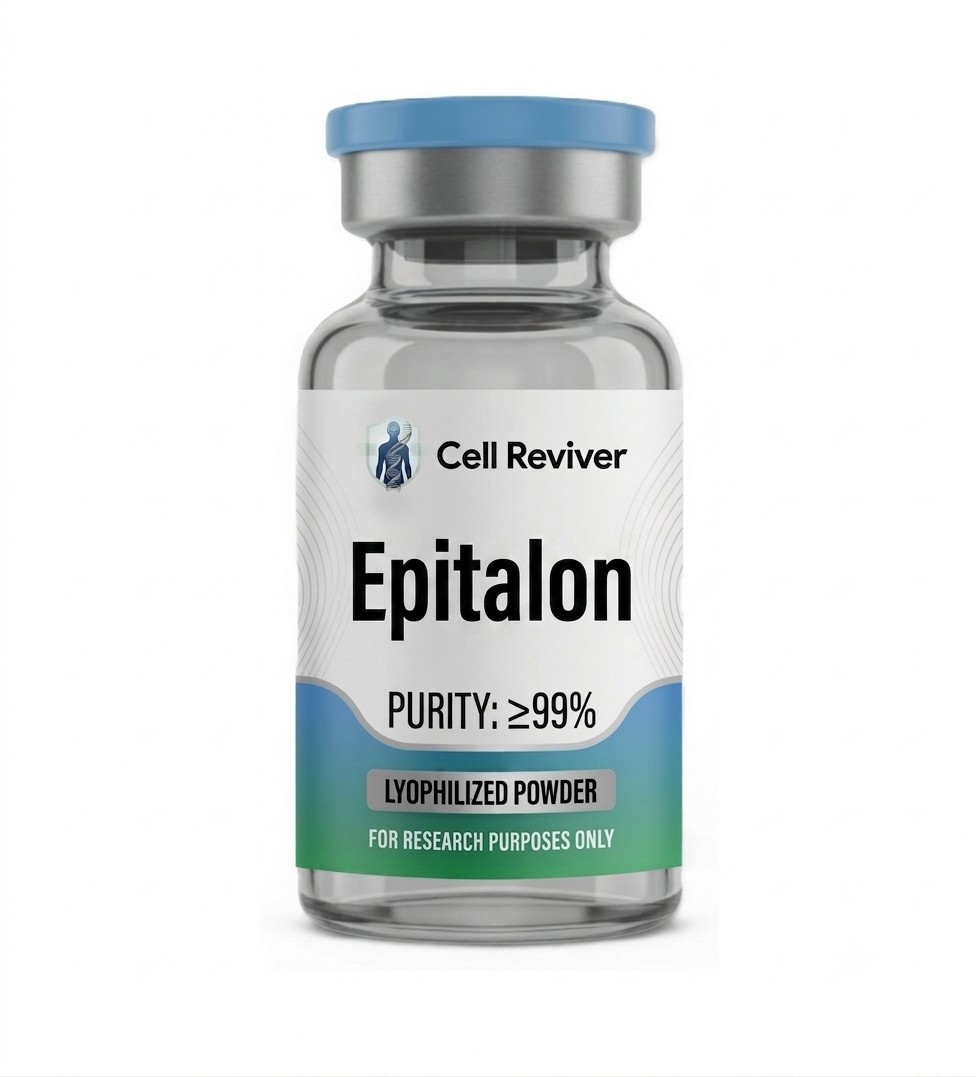
Epitalon Research Information
Pineal Tetrapeptide
For Longevity & Cellular Health Research
️ Important: This information is for educational and research purposes only. Always consult with a qualified healthcare professional before use.
Contents
What is Epitalon?
Epitalon (also known as Epithalon or Epithalone) is a synthetic tetrapeptide (Ala-Glu-Asp-Gly, AEDG) developed based on the amino acid composition of Epithalamin, a bovine pineal gland extract [citation:1][citation:5]. It has been extensively studied for its geroprotective and neuroendocrine effects, resulting from antioxidant, neuroprotective, and antimutagenic properties [citation:1].
As a fully defined molecule with a molecular weight of 390.35 Da, Epitalon eliminates the batch-to-batch variability of natural extracts, making it ideal for rigorous quantitative studies [citation:5]. It is available in pen and freeze-dried vial formulations for research purposes.
How Epitalon Works
Epitalon works through multiple mechanisms to support cellular health and longevity:
Telomerase Activation
Upregulates hTERT expression, leading to dose-dependent telomere elongation in human cell lines [citation:5]
Antioxidant Effects
Reduces ROS levels and restores wound healing by inhibiting hyperglycemia-induced fibrosis [citation:2][citation:9]
Pineal Regulation
Restores melatonin secretion patterns and circadian rhythms in aging models [citation:7]
Epitalon also modulates mRNA levels of interleukin-2 and enhances the activity of various enzymes, including telomerase and acetylcholinesterases [citation:1]. Its geroprotector effects occur at concentrations 16,000 to 80,000,000 times lower than those of melatonin in Drosophila models [citation:10].
Research Applications
Longevity Research
Studied for lifespan extension (11-16% in Drosophila) and telomere maintenance [citation:5][citation:10]
Sleep & Circadian Rhythm
Restores melatonin secretion and sleep architecture in older adults [citation:7]
Retinal Health
90% positive clinical effect in retinal degeneration; enhances wound healing in diabetic models [citation:2][citation:4]
Immune Function
Modulates T-lymphocyte development and improves immune system function in aging [citation:1]
Clinical Studies
Retinitis Pigmentosa Clinical Trial (Neuroendocrinology Letters 2002)
- Epitalon therapy in patients with degenerative retinal lesions resulted in a positive clinical effect in 90% of cases [citation:4]
- Application of Epitalon intensified the bioelectric and functional activity of the retina due to preservation of its morphological structure [citation:4]
Lifespan Extension (Drosophila melanogaster)
- Epitalon significantly increased lifespan by 11-16% at concentrations as low as 0.001×10⁻⁶ wt.% [citation:10]
- Effective concentrations were 16,000 to 80,000,000 times lower than those of melatonin [citation:10]
- Geroprotector effect was almost independent of substance concentration within the tested range [citation:10]
Wound Healing & Diabetic Retinopathy (Stem Cell Reviews and Reports 2025)
- Epitalon restored impaired wound healing in high glucose-injured retinal cells [citation:2]
- At concentrations of 20, 40, and 60 ng/mL, it inhibited hyperglycemia-induced epithelial-mesenchymal transition and fibrosis [citation:9]
- Reduced intracellular ROS levels and increased antioxidant gene expression [citation:2]
Telomere Elongation in Human Cells (2025)
- Epitalon treatment resulted in dose-dependent telomere elongation in normal epithelial and fibroblast cells [citation:5]
- Linked directly to hTERT mRNA upregulation and telomerase enzyme activity [citation:5]
Evidence Status
- Most clinical research originates from Russia and Eastern Europe [citation:7]
- Western peer-reviewed RCTs are limited; the peptide has not received FDA approval [citation:7][citation:11]
- Telomerase activation carries a theoretical cancer risk (telomerase is upregulated in ~90% of cancers) [citation:11]
Interactive Dosing Guide
Select your vial size and dose to see the corresponding volume, clicks, dosing frequency, and how many doses per vial:
️ Step 1: Select Your Vial Size
Step 2: Select Your Dose
Common research protocols: 5-10 mg per day for 20-day cycles [citation:7]. Animal studies used 1.0 µg/mouse (30-40 µg/kg) [citation:6].
Vial Size
50mg Vial
Selected Dose
5 mg
Doses per Vial
10 doses
Pen Clicks
30 clicks
Volume
0.30 mL
Protocol Level
Level 1 (Starting)
Recommended Schedule
Daily for 20 days - Loading Phase
️ Do not change your dose unless advised by a qualified professional.
Protocol Level Summary
Based on research protocols: 5-15 mg daily for 20-day cycles, repeated every 3-6 months [citation:7].
| Protocol Level | Target Dose | Frequency | Pen Clicks | Volume (mL) | Who It\'s For |
|---|---|---|---|---|---|
| Level 1 (Starting) | 5 mg | Daily | 30 clicks | 0.30 mL | New users, first 20-day cycle |
| Level 2 (Standard) | 7.5-10 mg | Daily | 45-60 clicks | 0.45-0.60 mL | Standard protocol |
| Level 3 (Advanced) | 12.5 mg | Daily | 75 clicks | 0.75 mL | If more response needed |
| Level 4 (Maximum) | 15 mg | Daily | 90 clicks | 0.90 mL | Experienced users only |
️ Do not change your dose unless advised by a qualified professional.
Vial Users (Insulin Syringe)
Add 3mL of bacteriostatic water to your freeze-dried vial and mix gently. After reconstitution, use the table below to draw your dose:
Vial Size
50mg vial with 3mL bac water
| Dose | Frequency | Units on Syringe | Volume (mL) | Protocol Level |
|---|
️ Always use a new sterile needle and syringe for each injection.
️ Safety & Precautions
Reported side effects are generally mild (injection-site reactions, occasional drowsiness). However, long-term human safety data is limited [citation:7].
- Injection site reactions: Mild redness or tenderness at injection site
- Drowsiness: Occasional, reported in clinical use [citation:7]
- Telomerase activation concern: Theoretical cancer risk; telomerase is upregulated in ~90% of cancers [citation:11]
Important Safety Considerations:
- Epitalon is not FDA-approved for any indication [citation:7]
- Most clinical research is from Russia and Eastern Europe; Western evidence is limited [citation:7][citation:11]
- Contraindicated in patients with active malignancy, severe endocrine disorders, or known peptide hypersensitivity [citation:7]
- Do not use if pregnant or breastfeeding [citation:7]
- Quality control of commercially available Epitalon is variable [citation:11]
️ Warning: Epitalon is an investigational peptide with limited human safety data. Telomerase activation carries a theoretical cancer risk. If you experience severe allergic reactions, difficulty breathing, or signs of anaphylaxis, seek immediate medical help.
References
- Overview of Epitalon—Highly Bioactive Pineal Tetrapeptide with Promising Properties. Dimensions. [citation:1]
- The Antioxidant Tetrapeptide Epitalon Enhances Delayed Wound Healing in an in Vitro Model of Diabetic Retinopathy. Stem Cell Reviews and Reports. 2025;21(6):1822-1834. [citation:2]
- Pineal-regulating tetrapeptide epitalon improves eye retina condition in retinitis pigmentosa. Neuroendocrinology Letters. 2002;23(4):365-368. [citation:4]
- Epitalon Technical Guide. Benchchem. [citation:5]
- Epitalon Peptide Therapy. Menscape Clinic. 2026. [citation:7]
- Effect of epitalon on the lifespan increase in Drosophila melanogaster. Mechanisms of Ageing and Development. 2000;120(1-3):51-60. [citation:10]
- Epitalon Peptide Evidence Score. Biomeme. [citation:11]
This information is for educational and research purposes only. Always consult with a qualified healthcare professional.
Last updated: July 2026