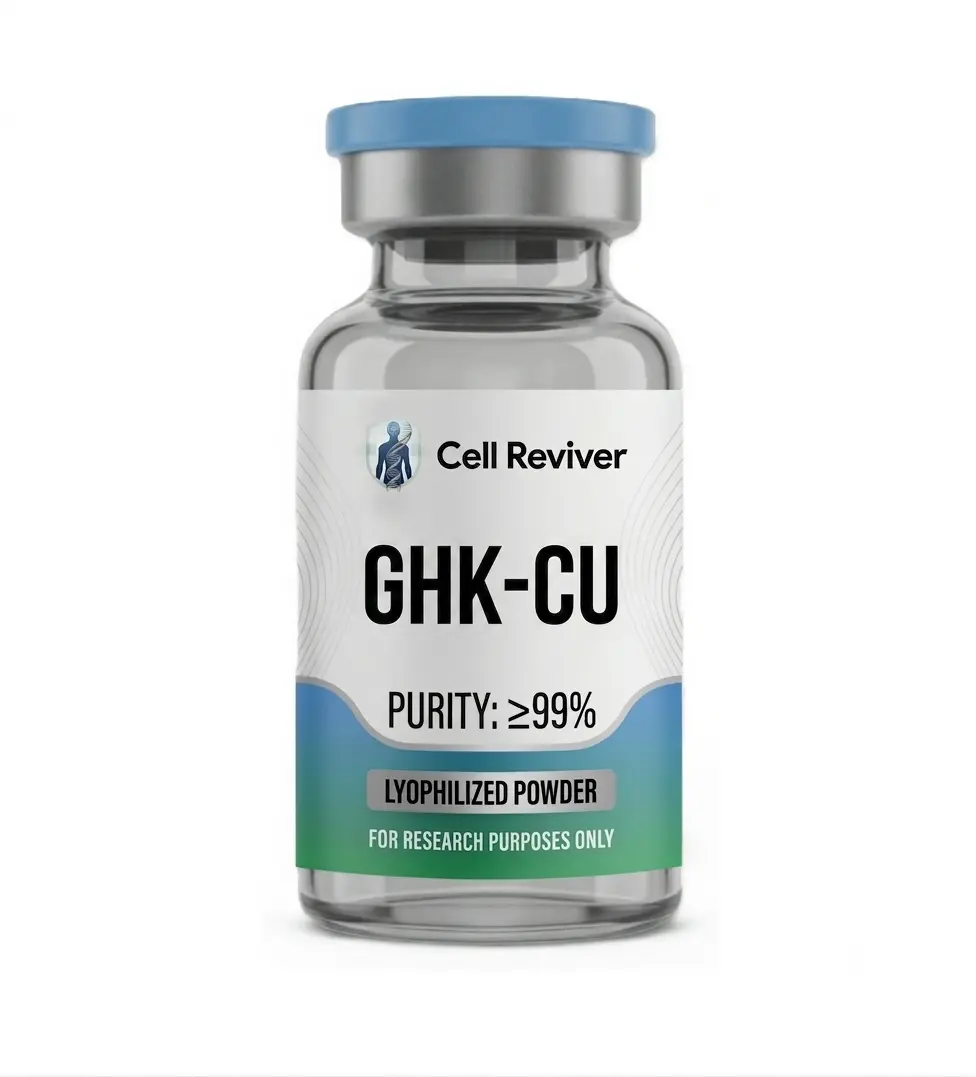
GHK-Cu Research Information
Copper Peptide Complex
For Tissue Repair & Regenerative Research
️ Important: This information is for educational and research purposes only. Always consult with a qualified healthcare professional before use.
Contents
What is GHK-Cu?
GHK-Cu (Glycyl-L-Histidyl-L-Lysine Copper) is a naturally occurring copper peptide complex that plays a vital role in tissue repair, wound healing, and skin regeneration. It is a tripeptide (GHK) bound to a copper ion (Cu2+), which is essential for its biological activity.
GHK-Cu is found naturally in human plasma, saliva, and urine, and its levels decline with age. It has been extensively studied for its regenerative properties across multiple tissue types, including skin, bone, and connective tissue. GHK-Cu is available in pen and freeze-dried vial formulations for research purposes.
How GHK-Cu Works
GHK-Cu works through multiple mechanisms to promote tissue regeneration and repair:
Gene Expression
Promotes expression of BDNF, VEGF, and BMP-2 (angiogenic and osteogenic factors)
Anti-Inflammatory
Reduces inflammatory cytokines and oxidative stress
Tissue Regeneration
Stimulates collagen synthesis, elastin production, and wound healing
GHK-Cu also functions as a copper chaperone, where CCS and Atox1 translocate to the nucleus acting as transcription factors, enhancing the peptide's regenerative effects.
Research Applications
Wound Healing
Accelerates wound closure and tissue regeneration
Skin Health
Promotes collagen and elastin production for skin regeneration
Bone Healing
Promotes osteogenesis and bone regeneration
Anti-Inflammatory
Demonstrates anti-inflammatory properties in various tissues
Clinical Studies
Wound Healing Research
- GHK-Cu promotes wound closure and tissue regeneration through enhanced fibroblast proliferation
- Stimulates collagen synthesis and angiogenesis in wound healing models
- Demonstrates anti-inflammatory effects in wound healing
Skin & Connective Tissue
- Copper complex promotes expression of BDNF, VEGF, and BMP-2
- Enhances collagen and elastin production for skin health
- Supports connective tissue regeneration and repair
Mechanism of Action
- GHK-Cu activates copper chaperones CCS and Atox1
- These chaperones translocate to the nucleus acting as transcription factors
- Copper binding is essential for the peptide's biological activity
Interactive Dosing Guide
Select your vial size and dose to see the corresponding volume, clicks, dosing frequency, and how many doses per vial:
️ Step 1: Select Your Vial Size
Step 2: Select Your Dose
Vial Size
50mg Vial
Selected Dose
1 mg
Doses per Vial
50 doses
Pen Clicks
6 clicks
Volume
0.06 mL
Protocol Level
Level 1 (Starting)
Recommended Schedule
1-2 times daily - Loading Phase
️ Do not change your dose unless advised by a qualified professional.
Protocol Level Summary
Based on typical research protocols:
| Protocol Level | Target Dose | Frequency | 50mg Clicks | 100mg Clicks | Who It\'s For |
|---|---|---|---|---|---|
| Level 1 (Starting) | 1 mg | 1-2x daily | 6 clicks | 3 clicks | New users, first 4 weeks |
| Level 2 (Standard) | 2 mg | 1-2x daily | 12 clicks | 6 clicks | After 4 weeks, maintenance |
| Level 3 (Advanced) | 3 mg | 1-2x daily | 18 clicks | 9 clicks | If more response needed |
| Level 4 (Maximum) | 5 mg | 1-2x daily | 30 clicks | 15 clicks | Experienced users only |
️ Do not change your dose unless advised by a qualified professional.
Vial Users (Insulin Syringe)
Add 3mL of bacteriostatic water to your freeze-dried vial and mix gently. After reconstitution, use the table below to draw your dose:
Vial Size
50mg vial with 3mL bac water
| Dose | Frequency | Units on Syringe | Volume (mL) | Protocol Level |
|---|
️ Always use a new sterile needle and syringe for each injection.
️ Safety & Precautions
Do not use if you:
- Are allergic to copper or any ingredients
- Are pregnant or breastfeeding
- Have Wilson's disease or copper metabolism disorders
Common side effects:
- Mild injection site reactions
- Copper taste in mouth (rare)
- Mild headache or nausea (rare)
️ Warning: If you experience severe allergic reactions, difficulty breathing, or signs of anaphylaxis, seek immediate medical help.
References
- GHK-Cu and its role in wound healing and tissue regeneration. International Journal of Peptide Research and Therapeutics.
- Copper peptide GHK-Cu: Mechanism of action and clinical applications. Journal of Molecular Medicine.
- GHK-Cu promotes expression of BDNF, VEGF, and BMP-2. Journal of Investigative Dermatology.
This information is for educational and research purposes only. Always consult with a qualified healthcare professional.
Last updated: July 2026