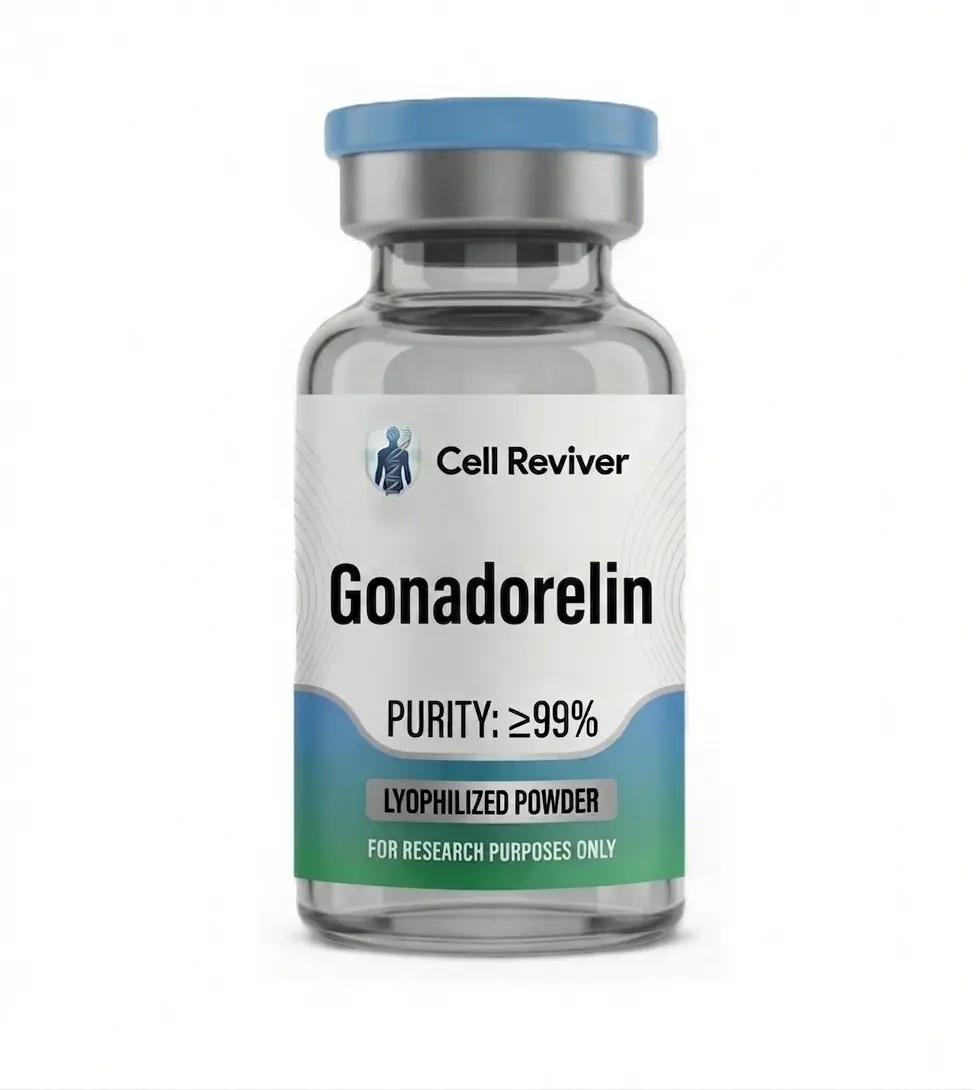
Gonadorelin Research Information
GnRH Agonist
For Reproductive & Hormonal Research
️ Important: This information is for educational and research purposes only. Always consult with a qualified healthcare professional before use.
Contents
What is Gonadorelin?
Gonadorelin is a synthetic 10-amino acid peptide that is identical to the endogenous Gonadotropin-Releasing Hormone (GnRH). It is also known as GnRH, luteinizing hormone-releasing hormone (LHRH), or gonadorelin acetate. It is a decapeptide (pyroGlu-His-Trp-Ser-Tyr-Gly-Leu-Arg-Pro-Gly-NH2) that plays a critical role in the regulation of the hypothalamic-pituitary-gonadal (HPG) axis.
Gonadorelin stimulates the release of luteinizing hormone (LH) and follicle-stimulating hormone (FSH) from the anterior pituitary gland. It has been used clinically for diagnostic and therapeutic purposes in reproductive medicine. Gonadorelin is available in pen and freeze-dried vial formulations for research purposes.
How Gonadorelin Works
Gonadorelin works through a targeted mechanism to regulate reproductive function:
GnRH Receptor
Binds to GnRH receptors on pituitary gonadotroph cells
LH & FSH Release
Stimulates the release of LH and FSH from the pituitary gland
HPG Axis Regulation
Regulates the hypothalamic-pituitary-gonadal axis
Gonadorelin is the primary regulator of the HPG axis, controlling the synthesis and secretion of gonadotropins, which in turn regulate gonadal function.
Research Applications
Reproductive Endocrinology
Studying HPG axis regulation and gonadotropin secretion
Diagnostic Testing
Used in diagnostic tests for hypothalamic-pituitary function
Fertility Research
Investigating therapeutic applications in fertility disorders
Pituitary Function
Researching pituitary gonadotroph function and response
Clinical Studies
Pituitary Function Testing
- Gonadorelin is used in diagnostic tests to assess pituitary function
- Stimulates LH and FSH release in a dose-dependent manner
- Used to differentiate between hypothalamic and pituitary disorders
Reproductive Research
- Gonadorelin is the standard peptide for GnRH research
- Studied for therapeutic applications in fertility disorders
- Used in combination with other hormones for reproductive research
Key Research Findings
- Gonadorelin is identical to endogenous GnRH
- Has a half-life of approximately 3-5 minutes
- Pulsatile administration stimulates LH and FSH release
Interactive Dosing Guide
Select your vial size and dose to see the corresponding volume, clicks, dosing frequency, and how many doses per vial:
️ Step 1: Select Your Vial Size
Step 2: Select Your Dose
Common research protocols: 0.01-0.1 mg per injection. Diagnostic tests use 0.05-0.1 mg.
Vial Size
5mg Vial
Selected Dose
0.05 mg
Doses per Vial
100 doses
Pen Clicks
3 clicks
Volume
0.03 mL
Protocol Level
Level 2 (Standard)
Recommended Schedule
As needed - Research Protocol
️ Do not change your dose unless advised by a qualified professional.
Protocol Level Summary
Based on research protocols: 0.01-0.1 mg per injection. Diagnostic tests use 0.05-0.1 mg.
| Protocol Level | Target Dose | Frequency | Pen Clicks | Volume (mL) | Who It\'s For |
|---|---|---|---|---|---|
| Level 1 (Starting) | 0.01-0.02 mg | As needed | 0.6-1.2 clicks | 0.006-0.012 mL | New users, first 2 weeks |
| Level 2 (Standard) | 0.05 mg | As needed | 3 clicks | 0.03 mL | Standard research dose |
| Level 3 (Advanced) | 0.1 mg | As needed | 6 clicks | 0.06 mL | Clinical testing dose |
| Level 4 (Maximum) | 0.2 mg | As needed | 12 clicks | 0.12 mL | Experienced users only |
️ Do not change your dose unless advised by a qualified professional.
Vial Users (Insulin Syringe)
Add 3mL of bacteriostatic water to your freeze-dried vial and mix gently. After reconstitution, use the table below to draw your dose:
Vial Size
5mg vial with 3mL bac water
| Dose | Frequency | Units on Syringe | Volume (mL) | Protocol Level |
|---|
️ Always use a new sterile needle and syringe for each injection.
️ Safety & Precautions
Gonadorelin has been used clinically for decades with a well-established safety profile. Adverse events are generally mild and transient.
- Injection site reactions: Mild redness or tenderness at injection site
- Hormonal effects: Temporary changes in LH and FSH levels
- Well-tolerated: Established safety profile in clinical use
Important Safety Considerations:
- Gonadorelin is FDA-approved for diagnostic use
- Used in reproductive medicine for diagnostic and therapeutic purposes
- Do not use if allergic to Gonadorelin or any ingredients
- Do not use if pregnant or breastfeeding
️ Warning: Gonadorelin stimulates LH and FSH release. Do not use during pregnancy. If you experience severe allergic reactions, difficulty breathing, or signs of anaphylaxis, seek immediate medical help.
References
- Gonadorelin Research Overview. Peptide Sciences.
- Gonadorelin Technical Guide. Benchchem.
- Gonadorelin: The Natural GnRH Peptide. Journal of Peptide Research.
This information is for educational and research purposes only. Always consult with a qualified healthcare professional.
Last updated: July 2026