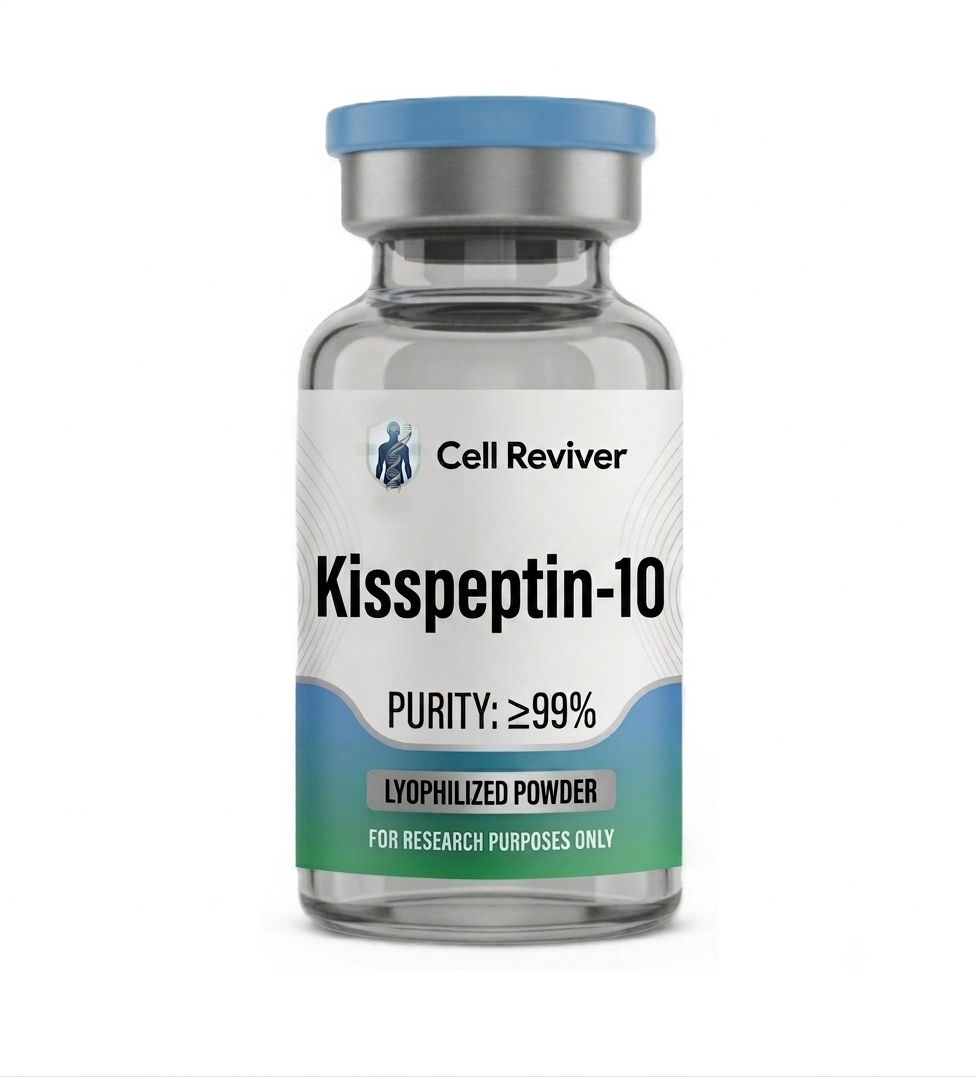
Kisspeptin-10 Research Information
GPR54 (KISS1R) Agonist
For Reproductive & Metabolic Research
️ Important: This information is for educational and research purposes only. Always consult with a qualified healthcare professional before use.
Contents
What is Kisspeptin-10?
Kisspeptin-10 (KP-10) is a synthetic decapeptide (YNWNSFGLRF-NH₂) that represents the C-terminal 10-amino acid sequence of the naturally occurring neuropeptide kisspeptin and is the minimal pharmacophore sufficient for full KISS1R (GPR54) activation. It is derived from the 145-amino acid KISS1 gene product, which is enzymatically cleaved into various kisspeptin isoforms including KP-10, KP-13, KP-14, and KP-54.
Initially characterized as a metastasis suppressor, kisspeptin is now recognized as the master regulator of the hypothalamic-pituitary-gonadal (HPG) axis, playing an essential role in puberty onset and reproductive function. Kisspeptin-10 binds to KISS1R with high affinity (Ki = 0.042 nM, ~8-fold higher than KP-54) and exhibits potent gonadotropin-releasing hormone (GnRH) stimulation. KP-10 is available in pen and freeze-dried vial formulations for research purposes.
How Kisspeptin-10 Works
Kisspeptin-10 works through multiple mechanisms to influence reproductive and metabolic physiology:
KISS1R Agonist
Binds to KISS1R (GPR54) with high affinity, activating GnRH neurons
HPG Axis Regulation
Stimulates GnRH, LH, and FSH secretion, regulating reproductive function
Metabolic Effects
Modulates food intake, energy expenditure, and glucose homeostasis
Kisspeptin-10 exhibits a very short plasma half-life of approximately 3.3 to 4 minutes in humans and 4 minutes in mice, enabling rapid, transient LH elevation that returns to baseline within approximately 1 hour. This makes KP-10 valuable for studying acute, pulsatile GnRH/LH dynamics. KP-10 is not able to cross the blood-brain barrier following peripheral administration, in contrast to the longer isoform KP-54.
Research Applications
Reproductive Endocrinology
Studying HPG axis regulation, puberty, and fertility disorders
Metabolic Health
Investigating obesity-diabetes, food intake, and energy balance
Cancer Research
Exploring metastasis suppression and apoptosis induction in breast cancer
Gut-Pancreatic Axis
Modulating enteroendocrine cells and pancreatic islet function
Clinical Studies
Metabolic Effects in Obesity-Diabetes (2025)
- In female high-fat diet (HFD) mice, twice-daily intraperitoneal KP-10 (25 nmol/kg) for 21 days decreased body weight, blood glucose, and energy intake to normal diet control levels
- KP-10 significantly (p < 0.05–0.01) decreased body weight and non-fasting blood glucose on days 7, 14, and 22
- By the end of the study, body weight and blood glucose were nearly identical in KP-10-treated HFD and healthy control mice
- KP-10 increased beta-cell proliferation with no alteration in beta-cell apoptosis
- Increased GIP-positive cells in ileum and restored relative insulin area to normal levels
Pharmacokinetics & Half-Life Studies
- KP-10 has a plasma half-life of approximately 3.3 to 4 minutes in humans
- In mice, KP-10 half-life is approximately 4 minutes, compared to ~32 minutes for KP-54
- Peak plasma KP-10 concentrations are observed 30 minutes after commencing intravenous infusion
- Plasma kisspeptin-IR falls nearly ten-fold within 30 minutes of cessation of infusion
- In vitro degradation half-lives: 6.8 min at 4°C, 2.9 min at 25°C, 1.7 min at 37°C
Sexual Dimorphism & Clinical Implications
- KP-10 robustly stimulates gonadotropin release in men but fails to stimulate gonadotropin release in healthy female volunteers in the follicular phase when administered by IV bolus, SC bolus, or IV infusion
- This reveals sexual dimorphism in responsiveness to KP-10 administration, with important clinical implications for potential therapeutic use
- Central administration of KP-10 decreased food intake in male mice (~50%), while increasing locomotor activity in female mice (>65%)
- Peripheral administration of KP-10 failed to alter any metabolic parameters analyzed except for small effects on locomotor activity and food intake, denoting a predominant central role in energy metabolism control
Triple-Negative Breast Cancer (2025)
- KP-10 treatment significantly reduced cell viability and migration in TNBC cell lines (IC₅₀: 110.21 nM for MDA-MB-231, 88.35 nM for MDA-MB-468)
- Induced dose-dependent upregulation of KISS1 mRNA, suggesting a positive feedback loop
- Modulated key transcription factors: upregulated GATA2, CDX2, and FLI1 while downregulating ZEB1
- EMT reversal evident from increased E-cadherin and β-catenin, reduced N-cadherin, CD44, and Vimentin
- Pro-apoptotic genes CASP3, CASP8, CASP9, and BAX were upregulated, while BCL2 was suppressed
Critical Research Considerations
- KP-10 is not able to cross the blood-brain barrier after peripheral administration, in contrast to KP-54
- KP-54 sustains LH release longer than KP-10, with repeated KP-10 dosing failing to reproduce KP-54's sustained LH profile
- Intravenous bolus doses of KP-10 ranging from 0.3–10 nmol/kg are associated with similar degrees of gonadotrophin secretion in healthy male subjects
Interactive Dosing Guide
Select your vial size and dose to see the corresponding volume, clicks, dosing frequency, and how many doses per vial:
️ Step 1: Select Your Vial Size
Step 2: Select Your Dose
Common research protocols: 0.01-0.1 mg per dose. Clinical studies used IV bolus 0.3-10 nmol/kg.
Vial Size
5mg Vial
Selected Dose
0.05 mg
Doses per Vial
100 doses
Pen Clicks
30 clicks
Volume
0.30 mL
Protocol Level
Level 2 (Standard)
Recommended Schedule
Twice daily - Research Protocol
️ Do not change your dose unless advised by a qualified professional.
Protocol Level Summary
Based on research protocols: 0.01-0.1 mg per dose, typically twice daily due to short half-life.
| Protocol Level | Target Dose | Frequency | 5mg Clicks | 10mg Clicks | Who It\'s For |
|---|---|---|---|---|---|
| Level 1 (Starting) | 0.01-0.02 mg | Twice daily | 6-12 clicks | 3-6 clicks | New users, initial protocol |
| Level 2 (Standard) | 0.05 mg | Twice daily | 30 clicks | 15 clicks | Common research dose |
| Level 3 (Advanced) | 0.1 mg | Twice daily | 60 clicks | 30 clicks | Higher dose range |
| Level 4 (Maximum) | 0.2 mg | Twice daily | 120 clicks | 60 clicks | Experienced users only |
️ Do not change your dose unless advised by a qualified professional.
Vial Users (Insulin Syringe)
Add 3mL of bacteriostatic water to your freeze-dried vial and mix gently. After reconstitution, use the table below to draw your dose:
Vial Size
5mg vial with 3mL bac water
| Dose | Frequency | Units on Syringe | Volume (mL) | Protocol Level |
|---|
️ Always use a new sterile needle and syringe for each injection.
️ Safety & Precautions
Kisspeptin-10 has shown a favorable safety profile in clinical studies with no dose-limiting toxicities or serious adverse events reported. However, human data is limited and KP-10 is not FDA-approved.
- Injection site reactions: Mild redness or tenderness at injection site
- Rapid degradation: Extremely short half-life minimizes systemic exposure
- Temperature-sensitive: Degrades rapidly at ambient temperature (t₁/₂ = 2.9 min at 25°C)
- No FDA approval: Investigational research compound only
Important Safety Considerations:
- KP-10 is not FDA-approved for any indication
- Sexual dimorphism in responsiveness: women in follicular phase may not respond
- Not BBB-penetrant after systemic administration
- Do not use if allergic to Kisspeptin-10 or any ingredients
- Do not use if pregnant or breastfeeding
️ Warning: Kisspeptin-10 is an investigational peptide. If you experience severe allergic reactions, difficulty breathing, or signs of anaphylaxis, seek immediate medical help.
References
- Kisspeptin-10 Ameliorates Obesity-Diabetes with Diverse Effects on Ileal Enteroendocrine Cells and Pancreatic Islet Morphology. Biomolecules. 2025;15(11):1591.
- Exogenous kisspeptin-10 treatment shows pleiotropy via induction of KISS1 expression, metastasis suppression, and promotes apoptosis in triple-negative breast cancer. Scientific Reports. 2025;15:35182.
- LC–MS/MS quantification of kisspeptin-10 and characterization of its decomposition product and pharmacokinetics in rats. J Chromatogr B. 2013.
- Kisspeptins centrally modulate food intake and locomotor activity in mice. J Neuroendocrinol. 2024;36(10).
- Mechanistic insights into the more potent effect of KP-54 compared to KP-10 in vivo. PLoS One. 2017;12(5).
- Kisspeptin-10 Technical Guide. Benchchem. 2026.
This information is for educational and research purposes only. Always consult with a qualified healthcare professional.
Last updated: July 2026