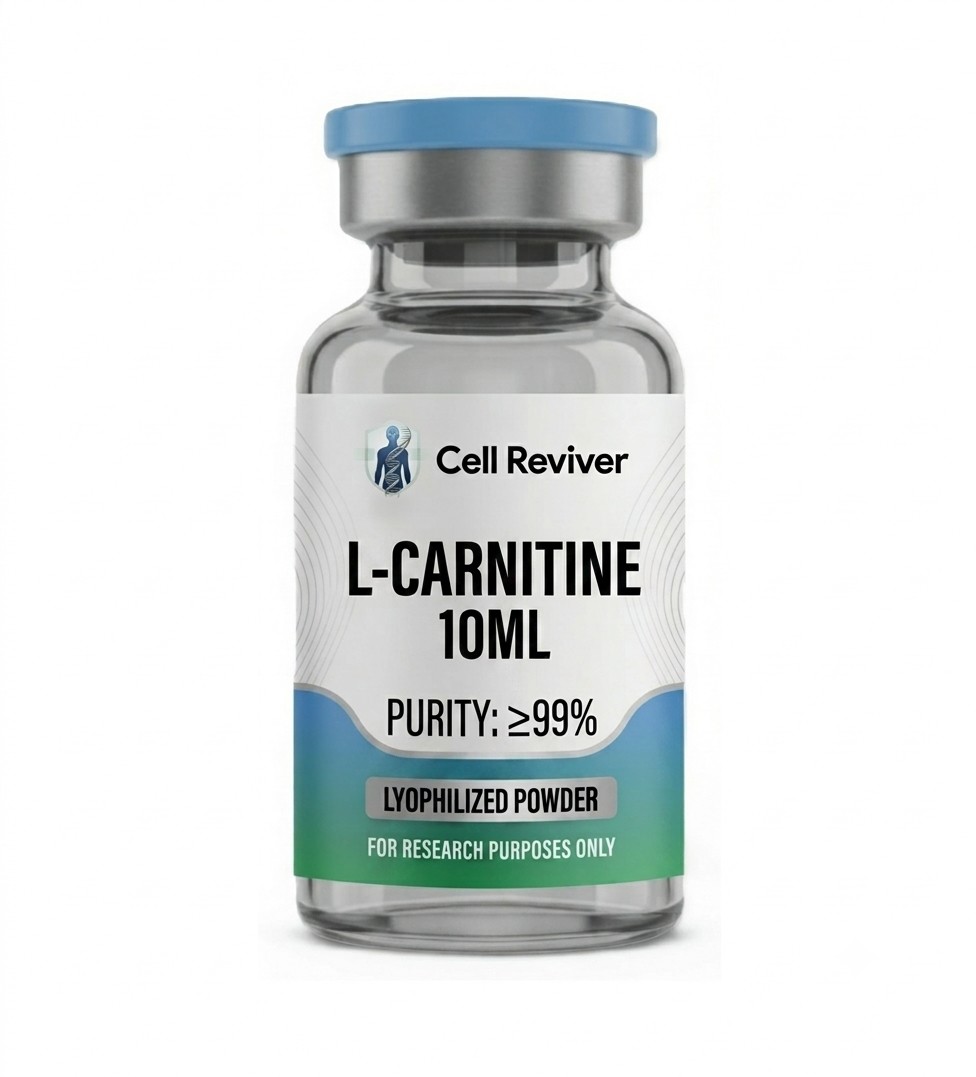
L-Carnitine Research Information
Amino Acid Derivative
For Metabolic & Cellular Energy Research
️ Important: This information is for educational and research purposes only. Always consult with a qualified healthcare professional before use.
Contents
What is L-Carnitine?
L-Carnitine is a naturally occurring amino acid derivative that plays an essential role in energy metabolism by facilitating the transport of long-chain fatty acids into the mitochondrial matrix for β-oxidation. It is synthesized in the liver and kidneys from the essential amino acids lysine and methionine, and is also obtained through dietary sources, primarily red meat.
Beyond its metabolic functions, L-carnitine demonstrates antioxidant and anti-inflammatory effects, protecting tissues from oxidative damage induced by reactive oxygen species. This formulation is for injectable research use, available in pen and freeze-dried vial formulations.
How L-Carnitine Works
L-Carnitine works through multiple mechanisms to support metabolic health and cellular energy:
Fatty Acid Transport
Transports long-chain fatty acids into mitochondria for energy production
Antioxidant
Reduces oxidative stress and protects against reactive oxygen species
Anti-Inflammatory
Reduces inflammatory markers including CRP, IL-6, and TNF-α
L-Carnitine plays a critical role in mitochondrial function and fatty acid metabolism, contributing to ATP production. During ischemic conditions, myocardial L-carnitine levels fall rapidly; supplementation can replenish depleted stores.
Research Applications
Cardiovascular Research
Studied for cardioprotective effects in coronary artery disease and heart failure
Metabolic Health
Investigating effects on lipid metabolism and mitochondrial function
Muscle & Sarcopenia
Improving muscle mass and function in sarcopenic patients
Liver Health
Ameliorating MASH and reducing inflammation in liver disease
Clinical Studies
Dialysis & Carnitine Deficiency (Nutrients 2020)
- Eighty Japanese outpatients (62 hemodialysis patients and 18 peritoneal dialysis patients) received injectable L-carnitine 600 mg/day for 12 months
- Total carnitine, free carnitine, and acylcarnitine concentrations significantly increased after treatment
- Decreased muscle cramping after L-carnitine treatment was reported by 31% of patients who had undergone HD for >4 years
- Hemoglobin concentrations increased significantly at 12 and 24 months in the HD group
Cardiovascular Meta-Analysis (2026)
- Systematic review of 21 studies found L-carnitine supplementation reduced all-cause mortality by 27%, ventricular arrhythmias by 65%, and angina by 40%
- Significant reductions in inflammatory markers including CRP, IL-6, and TNF-α
- Decreased malondialdehyde (MDA) levels and increased antioxidant enzyme activity (SOD, GSH-Px)
- Reduced cardiac injury markers including CK-MB and troponin-I
Liver Transplantation & Sarcopenia (Clinical Nutrition ESPEN 2025)
- RCT of 53 HCV-related cirrhotic patients awaiting liver transplantation
- L-Carnitine supplementation significantly improved post-transplant muscle mass index (1 vs. 0 cm²/m²; P = 0.014)
- Mortality was significantly lower in the L-carnitine group (16.7% vs. 55.6%; P = 0.003)
- Survival rates comparable to non-sarcopenic patients
Pediatric Cardiac Surgery (European Journal of Pediatrics 2024)
- RCT of 60 children with congenital heart disease undergoing open-heart surgery
- L-Carnitine 50 mg/kg/day for 1 month pre-surgery significantly reduced post-operative oxidative stress (MDA), apoptosis markers, and myocardial injury markers (CK-MB, troponin I)
- Improved post-operative left ventricular ejection fraction
Interactive Dosing Guide
Select your vial size and dose to see the corresponding volume, clicks, dosing frequency, and how many doses per vial:
️ Step 1: Select Your Vial Size
Step 2: Select Your Dose
Common research protocols: 50-300 mg per injection. Clinical studies used up to 600 mg/day injectable.
Vial Size
600mg Vial
Selected Dose
100 mg
Doses per Vial
6 doses
Pen Clicks
50 clicks
Volume
0.50 mL
Protocol Level
Level 2 (Standard)
Recommended Schedule
Daily - Standard Protocol
️ Do not change your dose unless advised by a qualified professional.
Protocol Level Summary
Based on research protocols: 25-300 mg per injection. Clinical studies used up to 600 mg/day injectable.
| Protocol Level | Target Dose | Frequency | Pen Clicks | Volume (mL) | Who It\'s For |
|---|---|---|---|---|---|
| Level 1 (Starting) | 25-50 mg | Daily | 12.5-25 clicks | 0.125-0.25 mL | New users, first 2 weeks |
| Level 2 (Standard) | 100 mg | Daily | 50 clicks | 0.50 mL | After 2 weeks, maintenance |
| Level 3 (Advanced) | 200 mg | Daily | 100 clicks | 1.00 mL | If more response needed |
| Level 4 (Maximum) | 300 mg | Daily | 150 clicks | 1.50 mL | Experienced users only |
️ Do not change your dose unless advised by a qualified professional.
Vial Users (Insulin Syringe)
Add 3mL of bacteriostatic water to your freeze-dried vial and mix gently. After reconstitution, use the table below to draw your dose:
Vial Size
600mg vial with 3mL bac water
| Dose | Frequency | Units on Syringe | Volume (mL) | Protocol Level |
|---|
️ Always use a new sterile needle and syringe for each injection.
️ Safety & Precautions
L-Carnitine is generally well-tolerated when dosed appropriately. In clinical studies, patients reported no side effects of intervention at 600 mg/day. The body excretes excess carnitine in urine.
- Mild gastrointestinal effects: Nausea or stomach upset at high doses
- Body odor: Fishy odor at very high doses (rare)
- Injection site reactions: Mild redness or tenderness at injection site
Important Safety Considerations:
- L-Carnitine is available as a dietary supplement and has a well-established safety profile
- Healthy individuals typically synthesize sufficient amounts without supplementation
- Do not use if allergic to L-Carnitine or any ingredients
- Do not use if pregnant or breastfeeding
️ Warning: If you experience severe allergic reactions, difficulty breathing, or signs of anaphylaxis, seek immediate medical help.
References
- Effects of l-Carnitine Supplementation in Patients Receiving Hemodialysis or Peritoneal Dialysis. Nutrients. 2020;12(11):3371.
- Therapeutic potential of L-carnitine in coronary artery disease: a systematic review. Inflammopharmacology. 2026;34:1331-1342.
- Impact of L-carnitine supplementation on post-transplant outcomes in liver transplant candidates with sarcopenia. Clinical Nutrition ESPEN. 2025;70:50-58.
- L-carnitine decreases myocardial injury in children undergoing open-heart surgery. European Journal of Pediatrics. 2024;183(6):2783-2789.
This information is for educational and research purposes only. Always consult with a qualified healthcare professional.
Last updated: July 2026