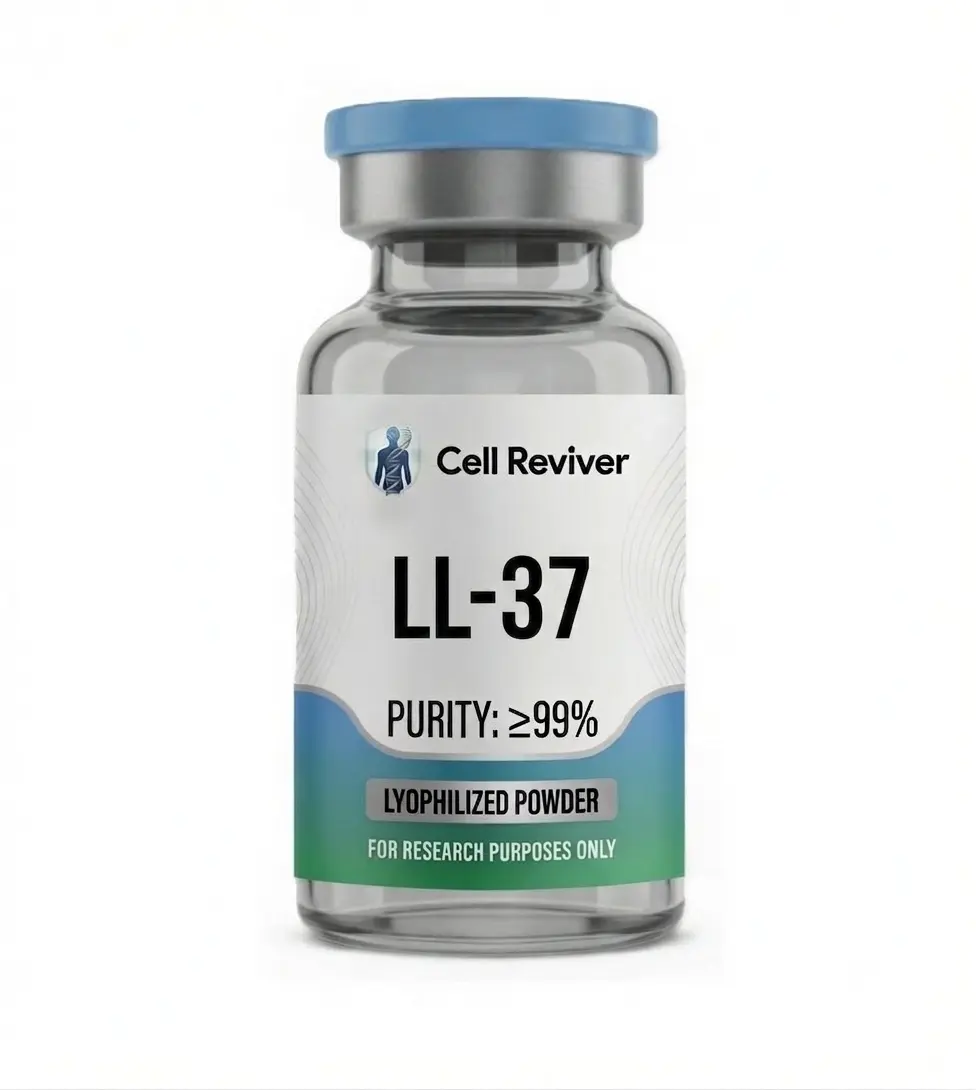
LL-37 Research Information
Human Cathelicidin Antimicrobial Peptide
For Antimicrobial & Immunomodulation Research
️ Important: This information is for educational and research purposes only. Always consult with a qualified healthcare professional before use.
Contents
What is LL-37?
LL-37 is a 37-amino acid antimicrobial peptide that is the only human cathelicidin peptide. It is expressed in various tissues, including epithelial cells, keratinocytes, and immune cells, and plays a critical role in innate immunity. It is also known as hCAP-18 (human cationic antimicrobial protein 18) in its precursor form.
LL-37 has broad-spectrum antimicrobial activity against bacteria, fungi, and viruses, as well as immunomodulatory and wound-healing properties. LL-37 is available in pen and freeze-dried vial formulations for research purposes.
How LL-37 Works
LL-37 works through multiple mechanisms to support innate immunity and tissue repair:
Antimicrobial
Broad-spectrum activity against bacteria, fungi, and viruses
Immunomodulation
Regulates immune responses and cytokine production
Wound Healing
Promotes tissue repair, angiogenesis, and cell migration
LL-37 plays a crucial role in the first line of defense against infections and is involved in the modulation of inflammatory responses.
Research Applications
Infectious Disease
Studying antimicrobial activity against pathogens
Immunomodulation
Investigating immune regulation and cytokine modulation
Wound Healing
Researching tissue repair and regenerative properties
Inflammatory Disorders
Studying role in autoimmune and inflammatory conditions
Clinical Studies
Antimicrobial Activity
- LL-37 exhibits broad-spectrum antimicrobial activity against Gram-positive and Gram-negative bacteria
- Effective against fungi and viruses in research models
- Acts by disrupting microbial cell membranes
Immunomodulatory Effects
- LL-37 regulates immune cell function and cytokine production
- Modulates inflammatory responses and promotes tissue repair
- Plays a role in the innate immune response
Key Research Findings
- LL-37 is the only human cathelicidin peptide
- Expressed in epithelial cells, keratinocytes, and immune cells
- Demonstrates both antimicrobial and immunomodulatory functions
Interactive Dosing Guide
Select your vial size and dose to see the corresponding volume, clicks, dosing frequency, and how many doses per vial:
️ Step 1: Select Your Vial Size
Step 2: Select Your Dose
Common research protocols: 0.05-0.5 mg per dose, typically administered daily or weekly.
Vial Size
5mg Vial
Selected Dose
0.2 mg
Doses per Vial
25 doses
Pen Clicks
12 clicks
Volume
0.12 mL
Protocol Level
Level 2 (Standard)
Recommended Schedule
Daily or weekly - Research Protocol
️ Do not change your dose unless advised by a qualified professional.
Protocol Level Summary
Based on research protocols: 0.05-0.5 mg per dose.
| Protocol Level | Target Dose | Frequency | Pen Clicks | Volume (mL) | Who It\'s For |
|---|---|---|---|---|---|
| Level 1 (Starting) | 0.05-0.1 mg | Daily/weekly | 3-6 clicks | 0.03-0.06 mL | New users |
| Level 2 (Standard) | 0.2 mg | Daily/weekly | 12 clicks | 0.12 mL | Standard research dose |
| Level 3 (Advanced) | 0.3 mg | Daily/weekly | 18 clicks | 0.18 mL | If more response needed |
| Level 4 (Maximum) | 0.5 mg | Daily/weekly | 30 clicks | 0.30 mL | Experienced users only |
️ Do not change your dose unless advised by a qualified professional.
Vial Users (Insulin Syringe)
Add 3mL of bacteriostatic water to your freeze-dried vial and mix gently. After reconstitution, use the table below to draw your dose:
Vial Size
5mg vial with 3mL bac water
| Dose | Frequency | Units on Syringe | Volume (mL) | Protocol Level |
|---|
️ Always use a new sterile needle and syringe for each injection.
️ Safety & Precautions
LL-37 has shown a favorable safety profile in research studies. Adverse events are generally mild and transient.
- Injection site reactions: Mild redness or tenderness at injection site
- Well-tolerated: No significant adverse events reported
- Limited human data: Most research is preclinical
Important Safety Considerations:
- LL-37 is not FDA-approved for any indication
- Human data is limited; most research is preclinical
- Do not use if allergic to LL-37 or any ingredients
- Do not use if pregnant or breastfeeding
️ Warning: LL-37 is an investigational peptide with limited human safety data. If you experience severe allergic reactions, difficulty breathing, or signs of anaphylaxis, seek immediate medical help.
References
- LL-37 Research Overview. Peptide Sciences.
- LL-37 Technical Guide. Benchchem.
- LL-37: The Human Cathelicidin Peptide. Journal of Peptide Research.
This information is for educational and research purposes only. Always consult with a qualified healthcare professional.
Last updated: July 2026