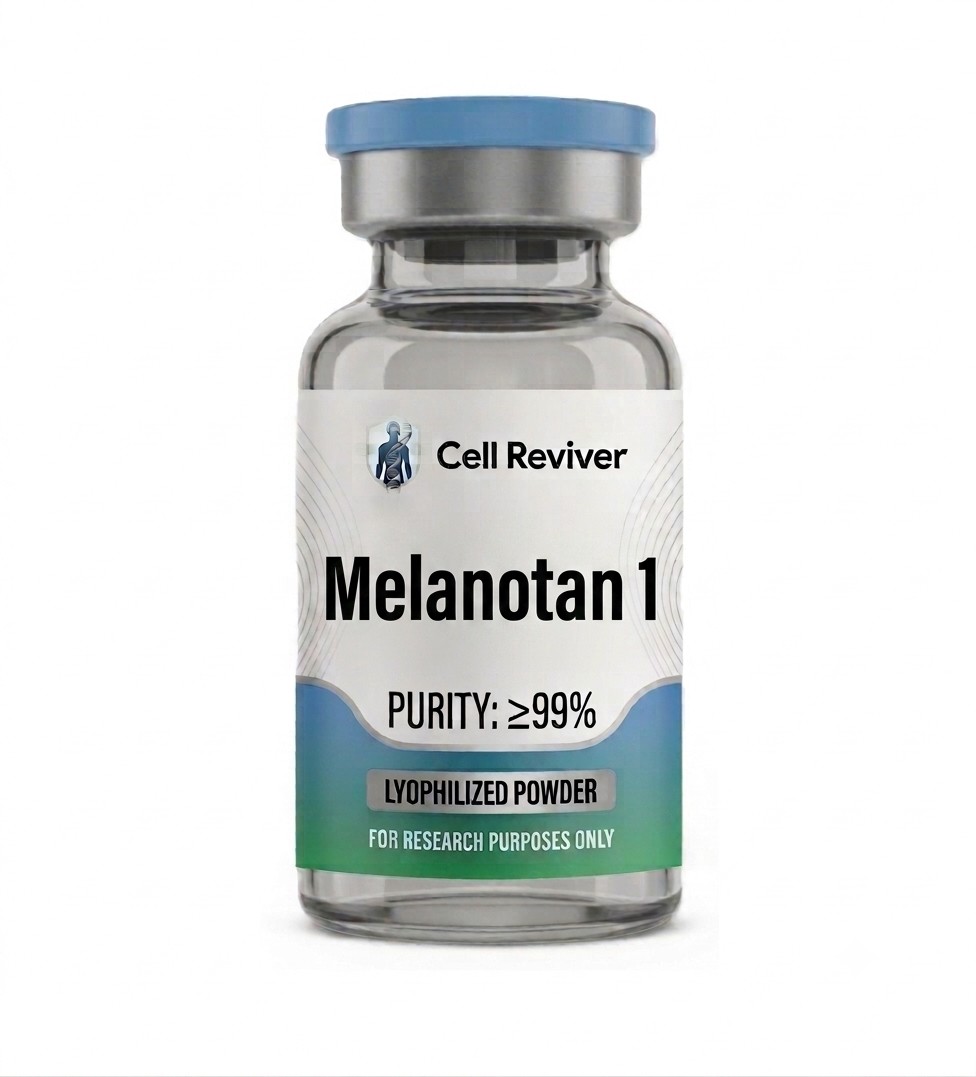
Melanotan 1 Research Information
Synthetic α-MSH Analog
For Pigmentation & Photoprotection Research
️ Important: This information is for educational and research purposes only. Always consult with a qualified healthcare professional before use.
Contents
What is Melanotan 1?
Melanotan 1 (also known as afamelanotide, [Nle4-D-Phe7]-α-MSH, or MT-I) is a synthetic 13-amino acid peptide analog of alpha-melanocyte-stimulating hormone (α-MSH) that acts as a potent melanocortin receptor agonist. It is the only FDA-approved melanotan peptide (approved in 2019 under the brand name Scenesse) for the treatment of erythropoietic protoporphyria (EPP) in adults.
Melanotan 1 is available in pen and freeze-dried vial formulations for research purposes.
How Melanotan 1 Works
Melanotan 1 works through a targeted mechanism to stimulate melanin production:
MC1R Agonist
Binds to melanocortin 1 receptor (MC1R) on melanocytes with high potency
Melanin Production
Stimulates melanogenesis and eumelanin production in the skin
Photoprotection
Increases skin's natural photoprotective pigment for UV protection
Melanotan 1 is a more receptor-specific analog of α-MSH compared to Melanotan 2, with greater selectivity for melanin production pathways, resulting in fewer side effects.
Research Applications
Photoprotection
Researching skin photoprotection and UV damage prevention
Skin Health
Studying melanogenesis and pigmentation pathways
Skin Conditions
Investigating EPP, solar dermatitis, and polymorphic light eruption
Immunomodulation
Researching immune response and anti-inflammatory effects
Clinical Studies
Phase 3 Clinical Trials (NEJM 2015)
Two pivotal Phase 3 randomized trials demonstrated the efficacy of afamelanotide (Melanotan 1) for erythropoietic protoporphyria (EPP):
| Trial | Participants | Median Pain-Free Sun Exposure | Placebo |
|---|---|---|---|
| US Trial | 94 EPP adults | 69.4 hours | 40.8 hours |
| EU Trial | 74 EPP adults | 6.0 hours | 0.8 hours |
Key finding: In the EU trial, the afamelanotide group had a median pain-free sun exposure of 6.0 hours vs 0.8 hours with placebo (p = 0.005).
Long-Term Follow-Up
- An observational study followed 115 EPP patients treated with 1,023 afamelanotide implants over up to 8 years and documented statistically significant improvements in light tolerance
- High compliance and low discontinuation rates were reported
- Implant-site reactions, nausea, and fatigue were the most commonly reported adverse events
Pharmacokinetics Study (Ugwu et al., 1997)
- Doses of 0.08 to 0.21 mg/kg subcutaneously were administered to three male volunteers
- SC dose is completely bioavailable compared to IV dosing
- Plasma half-lives: absorption phase 0.07-0.79 h; β-phase 0.8-1.7 h
- Significant tanning of forehead, arms, and neck was noted following dosing, peaking at 1 week and still present 3 weeks after completing the regimen
- 3.9% or less of the dose was recovered in the urine
Interactive Dosing Guide
Select your vial size and dose to see the corresponding volume, clicks, dosing frequency, and how many doses per vial:
️ Step 1: Select Your Vial Size
Step 2: Select Your Dose
Common protocol: Starting dose 0.2 mg/day, maintenance 0.1 mg 2-3x/week
Vial Size
10mg Vial
Selected Dose
0.2 mg
Doses per Vial
50 doses
Pen Clicks
6 clicks
Volume
0.06 mL
Protocol Level
Level 2 (Standard)
Recommended Schedule
Daily - Loading Phase (1-2 weeks)
️ Do not change your dose unless advised by a qualified professional.
Protocol Level Summary
Based on research protocols: Starting dose 0.2 mg/day for 1-2 weeks, maintenance 0.1 mg 2-3x/week.
| Protocol Level | Target Dose | Frequency | Pen Clicks | Volume (mL) | Who It\'s For |
|---|---|---|---|---|---|
| Level 1 (Starting) | 0.05-0.1 mg | Daily | 1.5-3 clicks | 0.015-0.03 mL | New users, first week |
| Level 2 (Standard) | 0.2 mg | Daily | 6 clicks | 0.06 mL | Loading phase (1-2 weeks) |
| Level 3 (Maintenance) | 0.1 mg | 2-3x weekly | 3 clicks | 0.03 mL | After tan achieved |
| Level 4 (Maximum) | 0.3-0.5 mg | Daily | 9-15 clicks | 0.09-0.15 mL | Experienced users only |
️ Do not change your dose unless advised by a qualified professional.
Vial Users (Insulin Syringe)
Add 3mL of bacteriostatic water to your freeze-dried vial and mix gently. After reconstitution, use the table below to draw your dose:
Vial Size
10mg vial with 3mL bac water
| Dose | Frequency | Units on Syringe | Volume (mL) | Protocol Level |
|---|
️ Always use a new sterile needle and syringe for each injection.
️ Safety & Precautions
Melanotan 1 has been studied extensively and has a manageable safety profile in clinical settings. The most common adverse events in clinical trials were implant-site reactions, nausea, and fatigue.
- Injection site reactions: Redness, tenderness, or pain at injection site
- Nausea: Mild and transient, more common during initial dosing
- Facial flushing: Occasional and temporary
- Gastrointestinal upset: Rare and usually mild
Important Safety Considerations:
- Only Melanotan 1 has FDA approval (for EPP), not for tanning
- Should only be purchased in clinical/research settings, not from unregulated online sources
- Do not use if allergic to Melanotan 1 or any ingredients
- Do not use if pregnant or breastfeeding
️ Warning: Melanotan 1 is approved only for erythropoietic protoporphyria, not for tanning. Products sold online are unregulated and may be unsafe. If you experience severe allergic reactions, difficulty breathing, or signs of anaphylaxis, seek immediate medical help.
References
- Langendonk JG, Balwani M, Anderson KE, et al. Afamelanotide for Erythropoietic Protoporphyria. New England Journal of Medicine. 2015;373:48-59.
- Biolcati G, Marchesini E, Sorge F, et al. Long-term observational study of afamelanotide in 115 patients with erythropoietic protoporphyria. British Journal of Dermatology. 2015;172(6):1601-1610.
- Chawathe A, et al. Investigation of the stability profile of therapeutic α-MSH analogue: Insights from LC-HRMS analysis of afamelanotide. J Pharm Biomed Anal. 2026;272:117362.
- Ugwu SO, Blanchard J, Dorr RT, et al. Skin pigmentation and pharmacokinetics of melanotan-I in humans. Biopharmaceutics and Drug Disposition. 1997;18(3):259-269.
- Melanotan I vs Melanotan II. ChemicalBook. 2024.
This information is for educational and research purposes only. Always consult with a qualified healthcare professional.
Last updated: July 2026