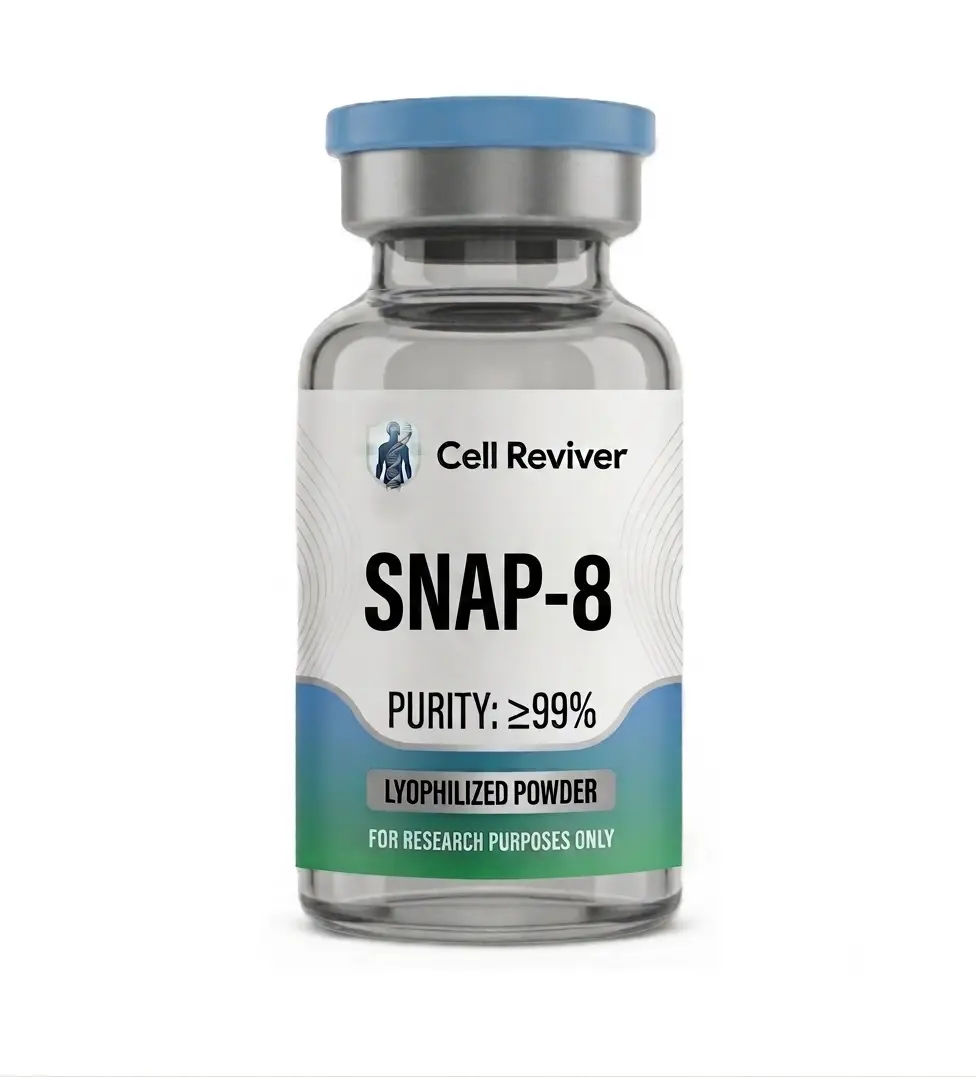
SNAP-8 Research Information
Acetyl Octapeptide-3
For Neuromodulation & Research Applications
️ Important: This information is for educational and research purposes only. Always consult with a qualified healthcare professional before use.
Contents
What is SNAP-8?
SNAP-8 (Acetyl Octapeptide-3, Acetyl Glutamyl Heptapeptide-1) is a synthetic octapeptide (Ac-Glu-Glu-Met-Gln-Arg-Arg-Ala-Asp-NH₂) that is an extended analog of the hexapeptide Argireline[citation:5][citation:9]. It is designed to mimic the N-terminal domain of the SNAP-25 protein, a key component of the SNARE complex involved in neurotransmitter release[citation:1][citation:5].
SNAP-8 has a molecular weight of 1075.16 g/mol and a molecular formula of C₄₁H₇₀N₁₆O₁₆S[citation:9][citation:10]. SNAP-8 is available in pen and freeze-dried vial formulations for research purposes.
How SNAP-8 Works
SNAP-8 works through a targeted mechanism to modulate neurotransmitter release:
SNAP-25 Mimicry
Mimics the N-terminal domain of SNAP-25, competing for binding sites in the SNARE complex[citation:5][citation:9]
SNARE Inhibition
Competitively inhibits SNARE complex formation, reducing vesicle fusion efficiency[citation:1][citation:5]
Neurotransmitter Modulation
Reduces acetylcholine release without causing complete paralysis[citation:9][citation:10]
SNAP-8 exerts its effects by competitively binding to syntaxin (Kd ≈ 0.8 µM) and synaptobrevin (Kd ≈ 2.3 µM), occupying the sites normally reserved for SNAP-25[citation:9]. This binding sterically hinders the formation of a functional SNARE complex, reducing the probability of neurotransmitter release[citation:9]. The C-terminal Ala-Asp-NH₂ extension enhances structural complementarity, resulting in approximately 30% greater potency than Argireline[citation:3][citation:10].
Research Applications
SNARE Complex Research
Studying protein-protein interactions and vesicle fusion dynamics[citation:1][citation:5]
Neurotransmission
Investigating synaptic vesicle fusion and calcium-dependent signaling[citation:5]
Peptide Engineering
Model compound for molecular mimicry and competitive inhibition studies[citation:1][citation:10]
Structural Biology
Molecular dynamics simulations and computational modeling of peptide-protein interactions[citation:1]
Clinical Studies
Head-to-Head Wrinkle Reduction Study
- A manufacturer-conducted clinical study with 17 female subjects over 28 days of twice-daily application demonstrated[citation:10]:
- SNAP-8 (10% solution, 0.005% pure peptide) reduced wrinkle depth by 34.98%
- Argireline (Acetyl Hexapeptide-3) under identical conditions reduced wrinkle depth by 27.05%
- SNAP-8 achieved ~29% relative improvement over Argireline[citation:10]
- Peak efficacy reached 63.13% reduction in periocular regions[citation:9][citation:12]
In Vitro SNARE Inhibition
- SNAP-8 demonstrated ~30% greater activity than Argireline in in vitro and in vivo efficacy testing[citation:3][citation:10]
- Binding affinities: Syntaxin-1 (Kd ≈ 0.8 µM), Synaptobrevin (Kd ≈ 2.3 µM), SNARE Complex (72% ± 4% inhibition)[citation:9]
- Inhibition of glutamate release: 43% at 1.5 mM concentration[citation:5]
Research Findings & Safety Profile
- SNAP-8 has been used in cosmetic formulations and research applications[citation:3][citation:12]
- Recommended formulation concentrations typically range from 3-10%[citation:7][citation:11]
- The peptide is water-soluble and stable at pH 5-6[citation:3][citation:10]
- No independent research validates the peptide's mechanism in humans[citation:11]
Interactive Dosing Guide
Select your vial size and dose to see the corresponding volume, clicks, dosing frequency, and how many doses per vial:
️ Step 1: Select Your Vial Size
Step 2: Select Your Dose
Common research protocols: 0.33-1.0 mg per injection. Gradual titration over 8-12 weeks[citation:8].
Vial Size
10mg Vial
Selected Dose
0.5 mg
Doses per Vial
20 doses
Pen Clicks
15 clicks
Volume
0.15 mL
Protocol Level
Level 2 (Standard)
Recommended Schedule
Once daily - Gradual Titration[citation:8]
️ Do not change your dose unless advised by a qualified professional.
Protocol Level Summary
Based on research protocols: 0.33-1.0 mg daily, gradual titration over 8-12 weeks[citation:8].
| Protocol Level | Target Dose | Frequency | Pen Clicks | Volume (mL) | Who It\'s For |
|---|---|---|---|---|---|
| Level 1 (Starting) | 0.33 mg | Once daily | 10 clicks | 0.10 mL | Weeks 1-4[citation:8] |
| Level 2 (Standard) | 0.5 mg | Once daily | 15 clicks | 0.15 mL | Weeks 5-8[citation:8] |
| Level 3 (Advanced) | 0.75 mg | Once daily | 22.5 clicks | 0.225 mL | Weeks 9-12[citation:8] |
| Level 4 (Maximum) | 1 mg | Once daily | 30 clicks | 0.30 mL | Weeks 13-16 (optional)[citation:8] |
️ Do not change your dose unless advised by a qualified professional.
Vial Users (Insulin Syringe)
Add 3mL of bacteriostatic water to your freeze-dried vial and mix gently. After reconstitution, use the table below to draw your dose:
Vial Size
10mg vial with 3mL bac water
| Dose | Frequency | Units on Syringe | Volume (mL) | Protocol Level |
|---|
️ Always use a new sterile needle and syringe for each injection.
️ Safety & Precautions
SNAP-8 has been used in cosmetic formulations and research applications[citation:3][citation:12]. In clinical studies, no serious adverse events were reported[citation:8]. However, comprehensive human safety data for injectable use is limited.
- Injection site reactions: Mild redness or tenderness at injection site
- Well-tolerated: No serious adverse events reported in clinical studies[citation:8]
- Limited human data: Comprehensive safety data for injectable use is lacking
Important Safety Considerations:
- SNAP-8 is not FDA-approved for any indication
- No independent research validates the peptide's mechanism in humans[citation:11]
- Products containing SNAP-8 are often classified as cosmetics, not drugs[citation:8]
- Do not use if allergic to SNAP-8 or any ingredients
- Do not use if pregnant or breastfeeding
️ Warning: SNAP-8 is an investigational peptide. If you experience severe allergic reactions, difficulty breathing, or signs of anaphylaxis, seek immediate medical help.
References
- SNAP-8: A Next-Generation Peptide Fragment in Molecular Communication Research. BioSpectrum Asia. 2026. [1]
- SNAP-8 (COL1A1 rs1800012) Skin Health. PlexusDx. 2026. [2]
- Cellbone Acetyl Glutamyl Heptapeptide-1. Shop. [3]
- Acetyl octapeptide-1 Documentation Hub. Benchchem. December 2025. [5]
- SNAP-8 (10mg Vial) Dosage Protocol. Peptide Dosages. 2025. [8]
- SNAP-8 (Acetyl Glutamyl Heptapeptide-3). EvitaChem. [9]
- Ac-glu-glu-met-gln-arg-arg-ala-asp-nh2. Benchchem. 2026. [10]
- Buy Snap-8 Peptide Vial Bulgaria. PharmaLabGlobal. 2025. [12]
This information is for educational and research purposes only. Always consult with a qualified healthcare professional.
Last updated: July 2026