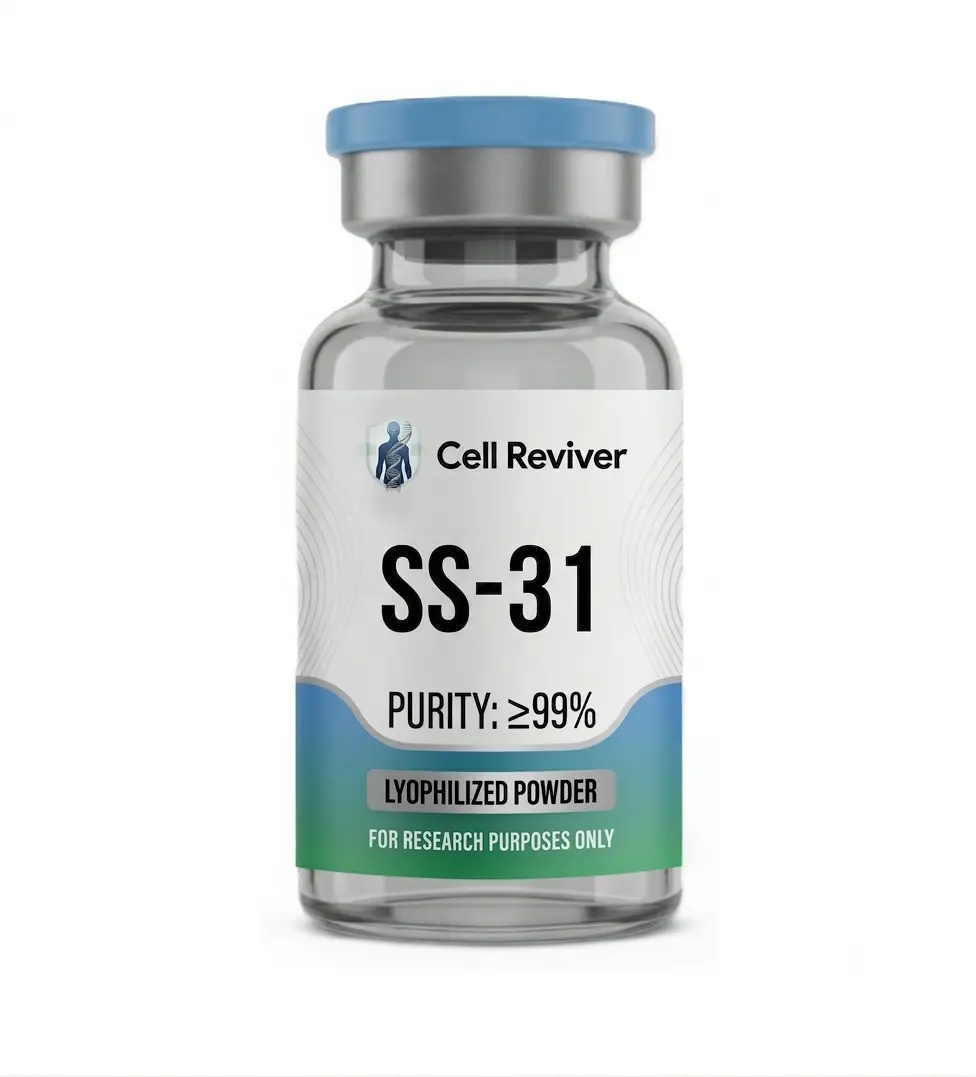
SS-31 Research Information
Mitochondrial-Targeted Peptide
For Mitochondrial Health & Cellular Energy Research
️ Important: This information is for educational and research purposes only. Always consult with a qualified healthcare professional before use.
Contents
What is SS-31?
SS-31 (also known as Elamipretide, Bendavia, and MTP-131) is a novel mitochondria-targeted tetrapeptide (D-Arg-dimethylTyr-Lys-Phe-NH2) that selectively targets the inner mitochondrial membrane [citation:6][citation:13]. It was co-discovered by Dr. Peter W. Schiller and Dr. Hazel Szeto and has been investigated in numerous preclinical studies and clinical trials for its remarkable mitochondrial protective properties [citation:1][citation:5].
SS-31 is a water-soluble small-molecule peptide featuring an alternating arrangement of basic amino acids and aromatic amino acids. This unique structural composition facilitates its passage through the blood-brain barrier, cell membranes, and mitochondrial membranes, with its accumulation on the mitochondrial inner membrane exceeding 1000-fold [citation:6]. SS-31 is available in pen and freeze-dried vial formulations for research purposes.
How SS-31 Works
SS-31 works through multiple mechanisms to protect mitochondrial function:
Cardiolipin Targeting
Selectively binds to cardiolipin on the inner mitochondrial membrane via electrostatic and hydrophobic interactions [citation:6][citation:9]
Antioxidant
Scavenges ROS, reduces oxidative stress, and preserves mitochondrial membrane integrity [citation:6][citation:13]
ATP Synthesis
Enhances mitochondrial bioenergetics and restores ATP production [citation:4][citation:12]
SS-31 prevents the opening of the mitochondrial permeability transition pore, which occurs during mitochondrial stress in traumatic brain injury, stroke, and neurodegenerative diseases [citation:9][citation:13]. Recent studies have also demonstrated SS-31's anti-inflammatory properties, including inhibition of NLRP3 inflammasome activation and suppression of LPS-stimulated IL-1β production [citation:4][citation:12].
Research Applications
Neuroprotection
Studied in Alzheimer's, Parkinson's, and traumatic brain injury models [citation:9][citation:13]
Cardiovascular
Phase 2 trials in heart failure showed improvements in cardiac function biomarkers [citation:6][citation:14]
Musculoskeletal
Preclinical studies show benefits in muscle aging, tendinopathy, and mitochondrial myopathy [citation:2][citation:6]
Ophthalmology
Successful treatment of chronic progressive external ophthalmoplegia (CPEO) [citation:1][citation:5]
Clinical Studies
Rare Eye Disease Breakthrough (2025)
- A patient with chronic progressive external ophthalmoplegia (CPEO) treated with SS-31 through an Expanded Access Program experienced dramatic symptom improvement after only two weeks [citation:1][citation:5]
- Improvements included: ability to raise eyebrows, recovery of eye mobility, improved muscle strength, balance, posture, and overall endurance [citation:1][citation:5]
Mitochondrial Myopathy & Barth Syndrome
- SS-31 has received FDA Rare Pediatric Disease designation for Barth syndrome [citation:14]
- TAZPOWER trial for Barth syndrome showed functional improvements [citation:14]
- Phase 3 trials for primary mitochondrial myopathy and age-related macular degeneration are ongoing [citation:1][citation:5]
Preclinical Studies
- In a murine supraspinatus tendinopathy model, SS-31 (5 mg/kg/d) improved mitochondrial function and promoted tendon healing [citation:2]
- In atherosclerosis research, SS-31 (1-3 mg/kg/d) suppressed atherosclerotic development in ApoE knockout mice [citation:15]
- SS-31 derivatives 5f and 5g showed significantly greater anti-inflammatory activity than SS-31 in cellular models [citation:4][citation:12]
Interactive Dosing Guide
Select your vial size and dose to see the corresponding volume, clicks, dosing frequency, and how many doses per vial:
️ Step 1: Select Your Vial Size
Step 2: Select Your Dose
Vial Size
5mg Vial
Selected Dose
1 mg
Doses per Vial
5 doses
Pen Clicks
60 clicks
Volume
0.60 mL
Protocol Level
Level 2 (Standard)
Recommended Schedule
Daily - Loading Phase
️ Do not change your dose unless advised by a qualified professional.
Protocol Level Summary
Based on clinical research protocols: 1-10 mg daily. The FDA-approved clinical dose is 40mg [citation:10].
| Protocol Level | Target Dose | Frequency | 5mg Clicks | 10mg Clicks | 50mg Clicks | Who It\'s For |
|---|---|---|---|---|---|---|
| Level 1 (Starting) | 1 mg | Daily | 60 clicks | 30 clicks | 6 clicks | New users, first 2 weeks |
| Level 2 (Standard) | 2 mg | Daily | 120 clicks | 60 clicks | 12 clicks | After 2 weeks, maintenance |
| Level 3 (Advanced) | 5 mg | Daily | 300 clicks | 150 clicks | 30 clicks | If more response needed |
| Level 4 (Maximum) | 10 mg | Daily | 600 clicks | 300 clicks | 60 clicks | Experienced users only |
️ Do not change your dose unless advised by a qualified professional.
Vial Users (Insulin Syringe)
Add 3mL of bacteriostatic water to your freeze-dried vial and mix gently. After reconstitution, use the table below to draw your dose:
Vial Size
5mg vial with 3mL bac water
| Dose | Frequency | 5mg Units | 10mg Units | 50mg Units | Protocol Level |
|---|
️ Always use a new sterile needle and syringe for each injection.
️ Safety & Precautions
SS-31 has shown a good safety profile in clinical trials. The most common adverse event is injection site reaction [citation:13][citation:14]. Treatments longer than 4 weeks have not been studied, so long-term safety is not established in humans [citation:13].
Do not use if you:
- Are allergic to SS-31 or any ingredients
- Are pregnant or breastfeeding
- Have pre-existing medical conditions (consult a healthcare professional first)
Common side effects:
- Mild injection site reactions [citation:13]
- Headache (rare)
- Mild fatigue or dizziness (rare)
️ Warning: If you experience severe allergic reactions, difficulty breathing, or signs of anaphylaxis, seek immediate medical help.
References
- Ansari, S. & Koenig, M.K. (2024). Clinical Case Reports, 12:e9591. [citation:1][citation:5]
- Zhang X, et al. SS-31 as a Mitochondrial Protectant in Tendinopathy. J Bone Joint Surg Am. 2022;104(21):1886-1894. [citation:2]
- Li M, et al. Discovery of novel SS-31 derivatives. RSC Adv. 2024;14:29789-29799. [citation:4][citation:12]
- SS-31 (Elamipretide) Review. Alzheimer's Drug Discovery Foundation. 2021. [citation:13]
- SS-31 Peptide Evidence Score. Biomeme. [citation:14]
- Li H, et al. SS-31 prevents atherosclerotic development. PLoS One. 2017;12(9):e0185688. [citation:15]
This information is for educational and research purposes only. Always consult with a qualified healthcare professional.
Last updated: July 2026