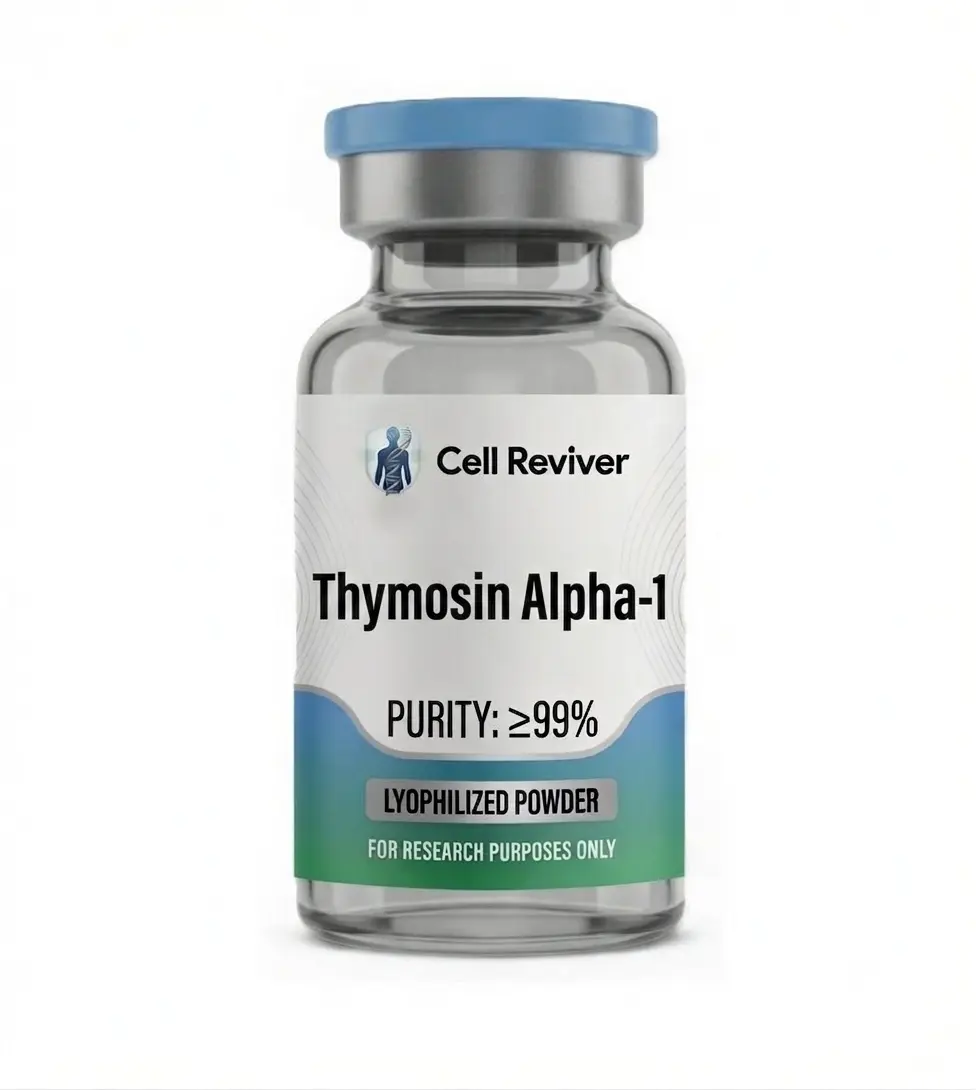
Thymosin Alpha-1 Research Information
Thymic Peptide
For Immunomodulation & Infection Research
️ Important: This information is for educational and research purposes only. Always consult with a qualified healthcare professional before use.
Contents
What is Thymosin Alpha-1?
Thymosin Alpha-1 (Tα1) is a synthetic 28-amino acid peptide (Ac-Ser-Asp-Ala-Ala-Val-Asp-Thr-Ser-Ser-Glu-Ile-Thr-Thr-Lys-Asp-Leu-Lys-Glu-Lys-Lys-Glu-Val-Val-Glu-Glu-Ala-Glu-Asn) that is a naturally occurring thymic peptide with potent immunomodulatory properties. It was originally isolated from the thymus gland and has been extensively studied for its ability to enhance immune function.
Thymosin Alpha-1 has been used clinically in various countries for over 30 years and has been investigated in numerous clinical trials for infectious diseases, cancer immunotherapy, and vaccine adjuvants. Tα1 is available in pen and freeze-dried vial formulations for research purposes.
How Thymosin Alpha-1 Works
Thymosin Alpha-1 works through multiple mechanisms to support immune function:
Immunomodulation
Stimulates T-cell maturation, NK cell activity, and antigen-presenting cells
Cytokine Regulation
Modulates IL-2, IFN-γ, and Toll-like receptor expression
Anti-Inflammatory
Activates the ERK1/2 pathway and modulates anti-inflammatory gene expression
In COVID-19 research, Tα1 reduced inflammatory cytokines including IL-6 and TNF-α in lung tissue. It activates the ERK1/2 pathway to modulate anti-inflammatory gene expression via AP-1 and NF-κB.
Research Applications
Immunomodulation
Studying immune system regulation and T-cell function
Cancer Research
Investigating immunomodulation in cancer and vaccine adjuvants
Infectious Disease
Researching hepatitis, COVID-19, and other viral infections
Vaccine Adjuvant
Enhancing vaccine responses as an immunomodulatory adjuvant
Clinical Studies
COVID-19 & SARS-CoV-2 Research (2026)
- In a COVID-19 mouse model, Tα1 administration reduced inflammatory cytokines IL-6 and TNF-α in lung tissue
- Activated the ERK1/2 pathway to modulate anti-inflammatory gene expression via AP-1 and NF-κB
- Prophylactic antiviral effect was observed in K18-hACE2 mice
- Mean survival time improved from 4.8 to 6.7 days
- Significant improvement in pulmonary injury and decreased viral load
Hepatocellular Carcinoma (2025)
- Thymosin α1 combined with blockade of the inhibitory receptor TIGIT significantly enhanced infiltration and function of tumor-infiltrating lymphocytes in mice
- Reduced IL-10-producing intratumoral regulatory T cell population
- Represented a novel strategy for HCC immunotherapy
Chronic Hepatitis B (2024)
- Meta-analysis of 11 RCTs involving 1,266 patients with CHB
- Long-term Tα1 therapy significantly enhanced host immune function
- Increased T-cell proliferation and cytokine production
Non-Small Cell Lung Cancer (2023)
- Meta-analysis of 8 RCTs including 611 patients
- Tα1 combined with chemotherapy significantly improved objective response rate, disease control rate, and quality of life in NSCLC patients
- Increased CD4+/CD8+ ratio and reduced adverse events
Vaccine Adjuvant Research (2024)
- Thymosin α1 in combination with vaccines for the prevention and treatment of infectious diseases and cancer
- Demonstrated success in clinical studies with hepatitis B and influenza vaccines
- Broad range of applications as an immunomodulatory agent
Interactive Dosing Guide
Select your vial size and dose to see the corresponding volume, clicks, dosing frequency, and how many doses per vial:
️ Step 1: Select Your Vial Size
Step 2: Select Your Dose
Common research protocols: 0.5-3.2 mg per dose. Clinical studies used 1.6 mg twice weekly for CHB.
Vial Size
5mg Vial
Selected Dose
1.6 mg
Doses per Vial
3.1 doses
Pen Clicks
96 clicks
Volume
0.96 mL
Protocol Level
Level 2 (Standard)
Recommended Schedule
Twice weekly - Clinical Protocol
️ Do not change your dose unless advised by a qualified professional.
Protocol Level Summary
Based on research protocols: 0.5-3.2 mg per dose. Clinical studies used 1.6 mg twice weekly for CHB.
| Protocol Level | Target Dose | Frequency | 5mg Clicks | 10mg Clicks | Who It\'s For |
|---|---|---|---|---|---|
| Level 1 (Starting) | 0.5-1 mg | Twice weekly | 30-60 clicks | 15-30 clicks | New users, first 2 weeks |
| Level 2 (Standard) | 1.6 mg | Twice weekly | 96 clicks | 48 clicks | Clinical protocol |
| Level 3 (Advanced) | 2 mg | Twice weekly | 120 clicks | 60 clicks | Higher dose range |
| Level 4 (Maximum) | 3.2 mg | Twice weekly | 192 clicks | 96 clicks | Maximum dose tested |
️ Do not change your dose unless advised by a qualified professional.
Vial Users (Insulin Syringe)
Add 3mL of bacteriostatic water to your freeze-dried vial and mix gently. After reconstitution, use the table below to draw your dose:
Vial Size
5mg vial with 3mL bac water
| Dose | Frequency | Units on Syringe | Volume (mL) | Protocol Level |
|---|
️ Always use a new sterile needle and syringe for each injection.
️ Safety & Precautions
Thymosin Alpha-1 has been used clinically for over 30 years with a favorable safety profile. Adverse events are generally mild and include injection site reactions.
- Injection site reactions: Mild redness, tenderness, or pain at injection site
- Mild gastrointestinal effects: Rare and usually mild
- Headache or fatigue: Occasional and mild
Important Safety Considerations:
- Thymosin Alpha-1 is not FDA-approved in the United States
- Used clinically in other countries for various indications
- Do not use if allergic to Thymosin Alpha-1 or any ingredients
- Do not use if pregnant or breastfeeding
️ Warning: Thymosin Alpha-1 is an investigational peptide in most countries. If you experience severe allergic reactions, difficulty breathing, or signs of anaphylaxis, seek immediate medical help.
References
- Thymosin α1 in COVID-19 Management. International Journal of Molecular Sciences. 2026.
- Thymosin Alpha-1 and TIGIT Blockade in HCC. Journal of Immunology. 2025.
- Thymosin α1: A Promising Immunomodulatory Agent. Human Vaccines & Immunotherapeutics. 2024.
- Thymosin α1 as a Vaccine Adjuvant. Clinical Immunology. 2024.
- Thymosin α1 for Chronic Hepatitis B. Journal of Viral Hepatitis. 2024.
- Thymosin α1 with Chemotherapy in NSCLC. Frontiers in Oncology. 2023.
This information is for educational and research purposes only. Always consult with a qualified healthcare professional.
Last updated: July 2026