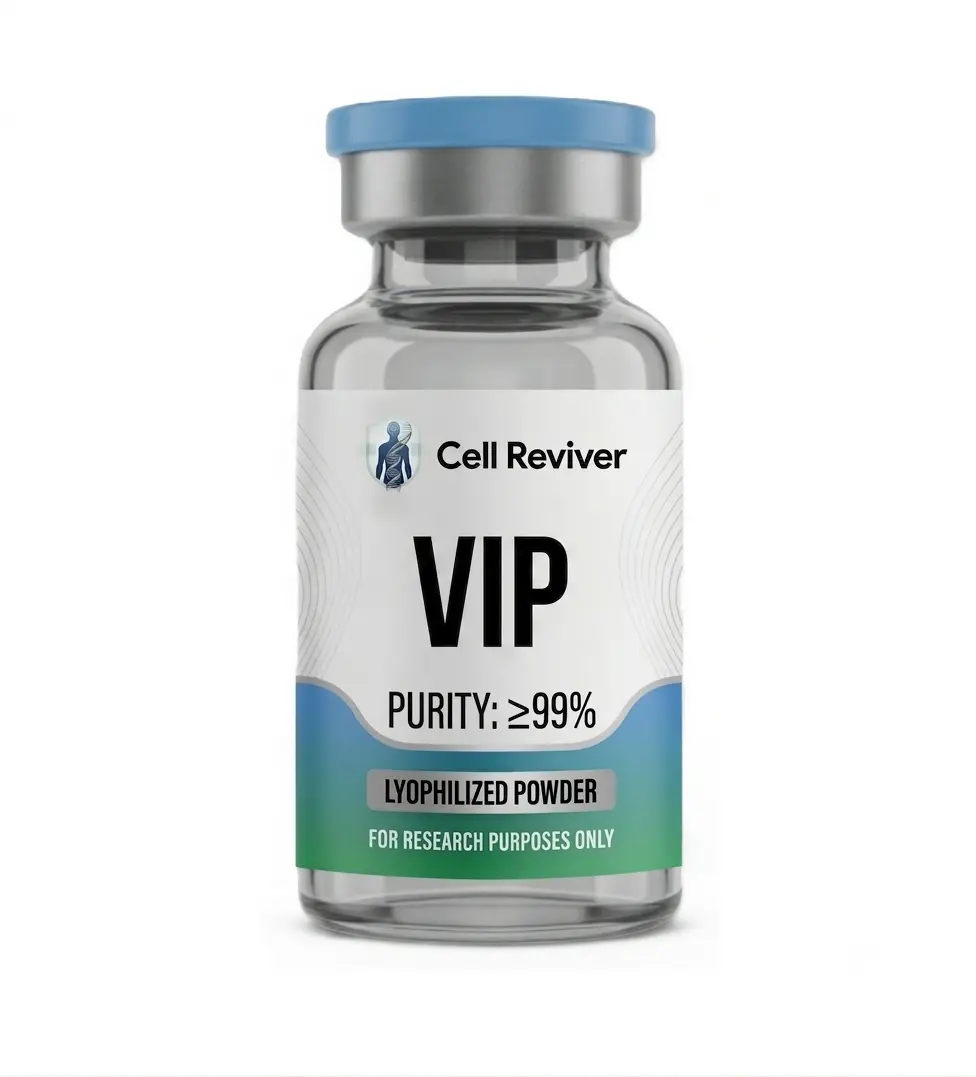
VIP Research Information
Vasoactive Intestinal Peptide
For Neuroendocrine & Immunomodulation Research
️ Important: This information is for educational and research purposes only. Always consult with a qualified healthcare professional before use.
Contents
What is VIP?
Vasoactive Intestinal Peptide (VIP) is a 28-amino acid neuropeptide that functions as a neuromodulator and neurotransmitter with potent vasodilatory, immunomodulatory, and anti-inflammatory properties [citation:1][citation:5]. It was first isolated from the small intestine and is remarkably well conserved across species (identical in human, cow, pig, rat, dog, and goat) [citation:1].
VIP is synthesized as a 170-amino acid precursor, cleaved to the active 28-amino acid peptide encoded by a gene on chromosome 6 [citation:1]. It shares 68% sequence homology with pituitary adenylyl cyclase-activating peptide (PACAP) and belongs to a unique class of G protein-coupled receptors [citation:1]. VIP is available in pen and freeze-dried vial formulations for research purposes.
How VIP Works
VIP works through multiple mechanisms to support neuroendocrine and immune function:
G Protein-Coupled Receptor
VIP receptors are a unique class of GPCRs with >50% sequence homology [citation:1]
Immunomodulation
Modulates immune function through effects on T cells, macrophages, and dendritic cells [citation:5][citation:11]
Vasodilation
Potent vasodilator that regulates smooth muscle activity and blood flow [citation:1][citation:12]
VIP is also involved in regulating epithelial cell secretion, smooth muscle activity, and blood flow in the gastrointestinal tract [citation:1]. It has been proposed as a therapeutic agent for several disorders including asthma, inflammation, and neurodegenerative conditions [citation:5].
Research Applications
Immunomodulation
Regulates Treg/Th17 balance, increases CD4+CD25+ Treg cells and TGF-β1 expression [citation:11]
Vascular Research
Studying vasodilation mechanisms and NO-dependent pathways [citation:12]
Inflammatory Models
EAE models show VIP reduces IFN-γ, IL-17A and inhibits astrocyte activation [citation:7][citation:11]
Respiratory Research
Natural bronchodilator in asthma; protects against histamine-induced bronchoconstriction [citation:2][citation:10]
Clinical Studies
Bronchodilation in Asthma (Lancet 1983)
- Seven asthmatic volunteers received intravenous VIP at 6 pmol/kg/min for 15 minutes in a double-blind study [citation:2][citation:10]
- Mean baseline FEV1 (81% predicted) increased by 0.21 L (range 0.1-0.45 L) after 15 minutes (p > 0.02) [citation:10]
- VIP significantly ameliorated histamine-induced bronchoconstriction in all subjects [citation:2]
- Tachycardia and cutaneous flushing were observed during infusion [citation:2][citation:10]
Experimental Autoimmune Encephalomyelitis (EAE) Models
- VIP at 4 and 16 nmol/kg (low and high dose) every other day for 10 days [citation:7][citation:11]
- Both doses decreased neurological dysfunction scores and extended incubation period in EAE rats [citation:7]
- Reduced IFN-γ and IL-17A levels in brain tissue, inhibited inflammatory cell infiltration and astrocyte activation [citation:7]
- Increased CD4+CD25+Treg/CD4+T cell ratio in spleen tissue and TGF-β1 expression in brain tissue [citation:11]
Endotoxic Shock Model
- Rats received 5 nmol VIP intravenous bolus following LPS [citation:4]
- VIP down-regulated pro-inflammatory cytokines (TNF-α, IL-1β) and up-regulated anti-inflammatory cytokine IL-10 [citation:4]
- Improved intestinal histopathological alterations induced by endotoxic shock [citation:4]
SARS-CoV-2 Entry Mechanism (2025)
- VIP downregulated ACE2 and TMPRSS2 mRNA and surface expression in epithelial cells [citation:8]
- VIP mediates shedding of ACE2 and TMPRSS2 via upregulation of ADAM10 sheddase protease [citation:8]
- Dual mechanism resulted in reduced infection rate by SARS-CoV-2 pseudovirus [citation:8]
Immunomodulation Review (2025)
- VIP modulates both innate and adaptive immunity through specific receptors [citation:5]
- Regulates T cell activation, differentiation, and macrophage/dendritic cell function [citation:5]
- Suggested therapies include impotence, skin disorders, asthma, neurodegenerative defects, and type 2 diabetes [citation:5]
Interactive Dosing Guide
Select your vial size and dose to see the corresponding volume, clicks, dosing frequency, and how many doses per vial:
️ Step 1: Select Your Vial Size
Step 2: Select Your Dose
Common research protocols: 0.01-0.5 mg per dose. Clinical studies used 6 pmol/kg/min infusion [citation:2][citation:10].
Vial Size
10mg Vial
Selected Dose
0.05 mg
Doses per Vial
200 doses
Pen Clicks
15 clicks
Volume
0.15 mL
Protocol Level
Level 2 (Standard)
Recommended Schedule
1-3 times daily - Research Protocol
️ Do not change your dose unless advised by a qualified professional.
Protocol Level Summary
Based on research protocols: 0.01-0.5 mg per dose. Clinical infusion: 6 pmol/kg/min .
| Protocol Level | Target Dose | Frequency | Pen Clicks | Volume (mL) | Who It\'s For |
|---|---|---|---|---|---|
| Level 1 (Starting) | 0.01-0.02 mg | 1-3x daily | 3-6 clicks | 0.03-0.06 mL | New users, first 2 weeks |
| Level 2 (Standard) | 0.05 mg | 1-3x daily | 15 clicks | 0.15 mL | Common research dose |
| Level 3 (Advanced) | 0.1 mg | 1-3x daily | 30 clicks | 0.30 mL | Higher dose range |
| Level 4 (Maximum) | 0.25-0.5 mg | 1-3x daily | 75-150 clicks | 0.75-1.50 mL | Experienced users only |
️ Do not change your dose unless advised by a qualified professional.
Vial Users (Insulin Syringe)
Add 3mL of bacteriostatic water to your freeze-dried vial and mix gently. After reconstitution, use the table below to draw your dose:
Vial Size
10mg vial with 3mL bac water
| Dose | Frequency | Units on Syringe | Volume (mL) | Protocol Level |
|---|
️ Always use a new sterile needle and syringe for each injection.
️ Safety & Precautions
VIP has shown a manageable safety profile in clinical studies. Common adverse effects from intravenous infusion include tachycardia and cutaneous flushing [citation:2][citation:10].
- Injection site reactions: Mild redness or tenderness at injection site
- Tachycardia: Observed during intravenous infusion [citation:2]
- Cutaneous flushing: Observed during intravenous infusion [citation:2]
Important Safety Considerations:
- VIP is not FDA-approved for any indication
- Clinical trials for VIP have been limited due to short half-life and stability issues [citation:9]
- VIP receptor antagonist studies are exploring chemical modifications to improve stability [citation:9]
- Do not use if allergic to VIP or any ingredients
- Do not use if pregnant or breastfeeding
️ Warning: VIP is an investigational peptide with limited clinical data. If you experience severe allergic reactions, difficulty breathing, or signs of anaphylaxis, seek immediate medical help.
References
- Vasoactive Intestinal Polypeptide. UpToDate. 2026. [citation:1]
- Morice A, et al. Vasoactive intestinal peptide causes bronchodilatation and protects against histamine-induced bronchoconstriction in asthmatic subjects. Lancet. 1983;2(8361):1225-1227. [citation:2]
- The Significance of Vasoactive Intestinal Peptide in Immunomodulation. ScienceDirect. 2025. [citation:5]
- Effects of vasoactive intestinal peptide on EAE rats. Military Medical Sciences. 2016. [citation:7]
- Effects of vasoactive intestinal peptide on CD4+CD25+Treg/CD4+T cell ratio and TGF-β1 expression in EAE rats. Journal of Xi'an Jiaotong University (Medical Sciences). 2017. [citation:11]
- VIP in COVID-19 Therapy—Shedding of ACE2 and TMPRSS2 via ADAM10. International Journal of Molecular Sciences. 2025;26(6):2666. [citation:8]
- Chemical Modifications to Enhance Drug Properties of a VIP Receptor Antagonist. International Journal of Molecular Sciences. 2024;25(8). [citation:9]
This information is for educational and research purposes only. Always consult with a qualified healthcare professional.
Last updated: July 2026